
If your product already has a working wallet, stablecoin card functionality can be added around the infrastructure you already operate.
The integration connects existing users and balances with card issuing, funding and authorization flows, provider APIs, transaction states, compliance processes, and card-management functionality.
For product teams, the key question is how the card layer should interact with the wallet architecture that is already in place.
If you are still defining the card program itself, start with How to Launch a Stablecoin Card Program: A Practical Guide for Fintechs. If you are already comparing issuing infrastructure, see Stablecoin Card Issuing Providers in 2026: What Fintechs Should Compare.
Yes. A custodial or non-custodial wallet can be connected to stablecoin card issuing infrastructure when the provider supports the wallet model, assets, target markets, and funding structure.
The wallet can remain the core product layer.
Card infrastructure then connects existing users and balances with traditional payment rails.
At a high level, the architecture may look like this:
Existing wallet → card funding / authorization layer → issuing infrastructure → card network → merchant
For the user, the card becomes another way to access value held within the product.
Behind that experience, the wallet and card systems need to remain synchronized.
Most of the existing wallet can remain in place, while several new connections are added around users, balances, transactions, compliance, and the product interface.
| Existing wallet layer | What changes when cards are added |
|---|---|
| Users | Existing users need to be connected with cardholder records in the issuing system |
| Balances | The card needs a defined funding source and rules for accessing stablecoin balances |
| Identity data | Additional cardholder KYC/KYB information may be required |
| Backend | Issuing APIs, webhooks, provider states, and new business logic are added |
| Transaction engine | Authorization, capture, reversal, refund, and settlement events need to be processed |
| Ledger | Card transactions need to reconcile with wallet balance changes |
| Mobile / web app | Card creation, activation, controls, limits, and transaction history become part of the product |
| Admin tools | Operations teams need visibility into users, cards, transactions, and provider events |
| Notifications | Card creation, spending, declines, freezes, refunds, and other events need user-facing communication |
This is why existing-wallet card integration is primarily an architecture and product-integration project.
Start with the architecture you already operate and define how card spending should fit into it.
Document:
These decisions help narrow down the issuing providers that can work with the existing product.
For a deeper comparison of provider models, see Stablecoin Card Issuing Providers in 2026: What Fintechs Should Compare.
There are several ways to connect wallet balances with card spending, and the funding model has a major impact on the integration architecture.
Three common models are worth separating.
The user moves funds from the wallet into a balance dedicated to card spending.
A simplified flow looks like:
Wallet balance → card balance → authorization → card transaction
This creates a clear boundary between the wallet balance and funds available to the card.
The product then needs to manage both balances and make the movement between them understandable to the user.
The card is funded when an authorization occurs.
The flow may look like:
Wallet balance → authorization request → funding / conversion → card transaction
The backend needs to coordinate available balance, authorization timing, provider events, conversion, and final transaction state.
This model can create a more seamless user experience because card funds do not need to be manually moved in advance.
Supported infrastructure can allow card spending to access a wallet balance directly.
Bridge currently documents non-custodial integrations that enable spending from user-controlled wallets without requiring a separate top-up balance. Its card infrastructure also supports custodial Bridge wallets and Stripe financial accounts.
This model can be especially relevant for products where the existing wallet architecture is an important part of the user experience.
The exact funding flow depends on the provider, supported chain, asset, and program structure.
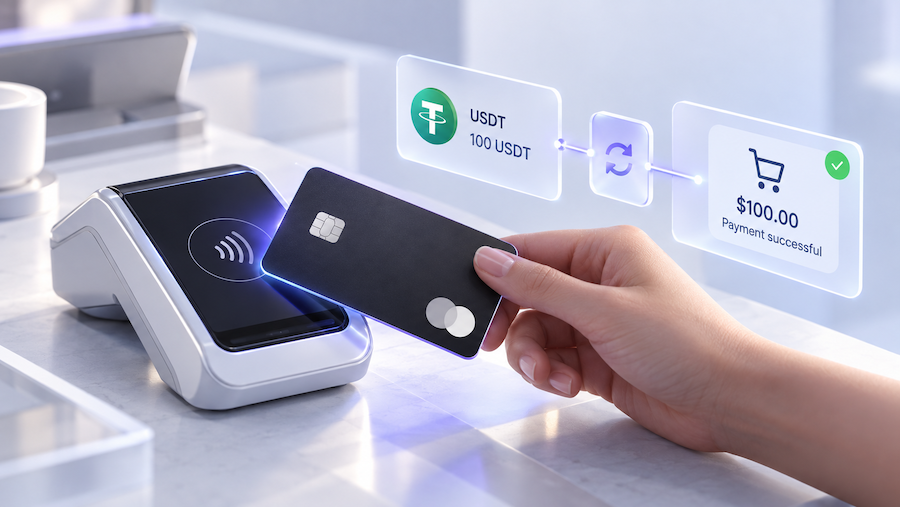
The backend becomes the coordination layer between the existing wallet, card provider, internal ledger, and user-facing applications.
The integration usually covers several areas.
The issuing provider creates its own cardholder records.
Your system needs a stable relationship between:
These identifiers should remain consistent throughout the card lifecycle.
They become essential for customer support, transaction investigation, and reconciliation.
The application may need to support actions such as:
Provider states should be mapped into clear product states that users and operations teams can understand.
Card infrastructure generates events throughout the transaction lifecycle.
Typical events include:
The backend needs to process these events reliably.
It should also account for delayed events, duplicated webhooks, retries, and events arriving in a different order than expected.
The product needs clear rules for when funds are checked, reserved, converted, debited, and returned.
For each transaction, define:
The provider’s card transaction and the wallet’s balance change may happen at different points in time.
The internal architecture has to connect them into one financial lifecycle.
Users should see one understandable transaction even when several infrastructure events happen behind it.
A single card purchase may create:
The wallet needs a transaction-state model that translates these events into a simple user experience.
For example:
Pending → Completed
Pending → Reversed
Completed → Refunded
The product can also distinguish declined, reversed, refunded, and disputed transactions when those states matter to the user.
This mapping becomes important for support as well. A customer asking about one purchase should not require an operations team to manually reconstruct several unrelated records.
Reconciliation keeps the wallet balance, provider transactions, and internal ledger aligned over time.
Card authorization, capture, settlement, reversal, and refund can happen at different times.
The final captured amount can also differ from the original authorization.
A reconciliation process should be able to answer questions such as:
At low transaction volume, these differences may be handled manually.
As volume grows, reconciliation becomes part of the core operating infrastructure.
Existing wallet users may need additional information or verification before a card can be issued.
The card program can introduce requirements such as:
Some information may already exist in the wallet.
The integration should identify which data can be reused and which fields need to be collected for the card program.
For the user, the onboarding experience should remain part of the same product journey.
Card controls should feel like a native part of the existing wallet experience.
Depending on the program, the application may need:
Existing wallet design patterns can often be reused.
Card transactions can share the same transaction-history structure as wallet activity while still displaying the states that are specific to card payments.
Card functionality introduces operational workflows that need to be visible outside the customer-facing application.
Operations teams may need tools for:
This layer is easy to overlook during early integration planning.
A technically working card program still needs to be manageable after launch.
Bridge and Stripe illustrate how card infrastructure can be connected to an existing wallet architecture.
Bridge’s current card product supports consumer and commercial programs, virtual and physical cards, fiat or stablecoin settlement, spending controls, dispute tooling, and multiple funding models.
Its documented funding options include:
For non-custodial use cases, Bridge documents integrations through Privy or Bridge smart contracts that allow direct spending from supported user-controlled wallets. Stripe also states that stablecoin-backed cards can be funded through custodial or non-custodial wallets, including an existing wallet.
For a wallet product, this creates a model where the existing wallet can remain central to the architecture while the issuing layer is connected around it.
The product team then defines how users, balances, APIs, transaction states, card controls, and operations work together.
The biggest risks usually come from unclear ownership of balances, transaction states, and provider responsibilities.
Every system should have a defined responsibility.
For example, the wallet may own the customer balance while the provider owns card authorization state.
The architecture needs rules for how those records are reconciled.
Authorization confirms that the transaction can proceed at that moment.
Capture, settlement, reversal, and refund can happen later.
The product needs to represent the complete lifecycle.
Card programs depend heavily on asynchronous events.
Idempotency, retries, event ordering, and failure handling should be part of the backend design.
The first integration plan often focuses on the customer application.
Card support also creates work for operations, finance, compliance, and customer support teams.
Wallet architecture affects provider fit.
Custody model, supported chains, balances, geography, and transaction logic should be documented before finalizing the issuing integration.
Existing-wallet integration works well when the wallet already provides a strong foundation for users, balances, transactions, and product UX.
Typical scenarios include:
The integration scope depends on how much of the existing architecture can support card transaction requirements.
Some products may need relatively focused provider integration.
Others may need deeper changes to the ledger, balance model, compliance flow, or backend.
ND Labs builds and integrates the product layer between an existing wallet and the selected card infrastructure provider.
For an existing-wallet project, this can include:
The issuing provider supplies the card infrastructure within its program.
ND Labs connects that infrastructure with the wallet, backend, business logic, and customer experience.
For companies adding cards to an existing wallet or building a complete wallet-and-card product, see White Label Stablecoin Card Infrastructure.
Before development begins, confirm:
A defined architecture makes provider integration easier to scope and reduces redesign during implementation.
Yes.
An existing wallet can remain the user, balance, and product layer while card issuing infrastructure is connected around it.
The implementation depends on the wallet architecture, assets, markets, and selected provider.
Usually, the existing wallet can continue to operate when the selected provider supports its architecture.
The integration connects the existing product with the provider’s cardholder, funding, and transaction infrastructure.
It depends on the funding model.
A program may use a dedicated card balance, just-in-time funding, or supported direct-wallet spending.
The provider and wallet architecture determine which models are available.
Yes.
Current infrastructure can support card programs connected to non-custodial wallets. Bridge and Stripe, for example, document stablecoin-backed card funding from supported non-custodial wallets.
The exact flow depends on the program.
Stablecoin value may be transferred, reserved, converted, or debited as part of the funding and settlement process while the merchant receives payment through the card network.
The issuing structure defines the cardholder verification requirements.
The wallet product integrates the required onboarding flow, while the relevant provider or compliance partner processes the regulated verification within its scope.
Compare providers against the existing wallet architecture.
Key criteria include target markets, wallet compatibility, supported stablecoins and chains, funding model, settlement, compliance responsibilities, APIs, webhooks, and operational tooling.
See Stablecoin Card Issuing Providers in 2026: What Fintechs Should Compare for the detailed provider comparison.
An existing wallet already provides valuable infrastructure: users, balances, transaction logic, and a customer-facing product.
Card functionality extends that foundation into a new spending use case.
The core integration connects card issuing with the wallet systems the business already operates and keeps the transaction experience consistent across both layers.
ND Labs builds this product and technology layer through its White Label Stablecoin Card Infrastructure service for existing wallets and new wallet-and-card products.