
Mystery packs are becoming a natural part of digital collectible platforms.
Instead of choosing a specific item, a customer buys a pack without knowing exactly what they will receive. The result may be a common collectible, a rare edition, or an item with significantly greater value.
The mechanic itself is not new. Trading cards, blind boxes and collectible toys have used surprise for decades. Digital platforms simply make the model more flexible: a collectible can be revealed instantly, added to a user’s collection, stored, transferred or resold without leaving the platform.
For businesses selling comics, trading cards, memorabilia and other collectibles, this creates a much bigger opportunity than simply adding a “mystery box” feature.
A mystery pack can become one part of a complete digital collectible ecosystem:
Purchase → Reveal → Ownership → Collection → Marketplace → Resale or Delivery
The important part is what happens after the reveal.
Gacha is a randomized reward mechanic where a user receives one item from a predefined pool.
A typical flow is simple:
Purchase → Random selection → Reveal → Item added to collection
The name comes from Japanese capsule toy machines, where customers pay before knowing which toy they will receive.
The same principle is now used across games, digital collectibles, trading cards and online marketplaces.
Possible rewards can include:
Items can have different rarity levels, supply and market value.
That combination of uncertainty, scarcity and ownership is what makes the mechanic attractive to collectors.
Mystery packs add a layer of engagement that a standard ecommerce transaction does not have.
When customers purchase a normal item, the transaction ends once the purchase is complete.
With a mystery pack, the purchase creates another interaction: the reveal.
Animation, sound, rarity indicators and visual effects can turn opening the pack into a product experience of its own.
Collecting becomes more engaging when some assets are harder to obtain than others.
A platform might create tiers such as:
But rarity does not have to be purely artificial.
It can reflect actual supply.
For example:
1 of 50 copies
or
Limited to 250 collectibles
For physical collectibles, rarity can also come from the item itself: edition, grading, condition, year or provenance.
A mystery pack creates a different customer journey from a one-time purchase:
Buy → Reveal → Collect → Trade → Complete a set → Return
This is why mystery mechanics can be relevant far beyond gaming.
Businesses building these experiences may combine randomized packs with digital ownership, tokenized assets, branded collectibles and other functionality described in ND Labs’ NFT Development services.
The same infrastructure can support very different collectible categories.
A platform can create mystery packs containing graded or limited-edition comics.
After the reveal, the comic appears in the user’s collection and can remain in storage, be resold or be shipped to the owner.
Sports cards, TCG cards or entertainment collectibles are particularly suited to randomized packs because collecting sets and chasing rare items are already familiar customer behaviors.
Mystery drops can combine cards, signed items, digital memorabilia, tickets or limited fan collectibles.
A physical blind-box product can have a digital layer where ownership, rarity and collections are managed before or after fulfillment.
Characters, skins, digital collectibles or merchandise can be distributed through limited drops and randomized packs.
The user experience may be different in each case, but the underlying infrastructure is similar.
This distinction is important.
A mystery pack determines how the user receives an item.
A marketplace determines what the user can do with that item afterwards.
Imagine a comic platform.
The company sells a $30 mystery pack.
A customer opens it and receives a particular graded comic.
At this point, the user might:
The first transaction is between the business and the customer.
If the collectible is later listed for sale, the next transaction may be between two users.
The model becomes:
Primary Sale → Reveal → Ownership → Secondary Marketplace
This distinction matters because a business can start with primary sales and mystery packs and later add secondary trading without rebuilding the entire product.
The ownership layer connects both models.
For companies that want to start from an existing marketplace foundation rather than build every component from scratch, ND Labs’ White Label NFT Marketplace includes core marketplace functionality such as listings, payments, wallet integration, seller flows and configurable marketplace fees.
One of the most interesting models appears when the digital asset represents a real physical collectible.
Consider a graded comic stored in a professional vault.
A customer purchases a mystery pack and receives ownership of that specific comic.
The comic does not have to be shipped.
Instead, it appears in the user’s digital collection together with information such as:
The user can then keep the item in the vault.
If they sell it to another user, only the ownership record needs to change.
The physical comic stays where it is.
Shipping happens only if an owner decides to redeem the asset and request delivery.
This removes a significant amount of friction from secondary trading.
Instead of:
Buy → Ship → Resell → Ship → Resell → Ship
the model becomes:
Store once → Transfer ownership digitally → Ship only when requested
For high-value collectibles, this can be particularly important.
We explored this model in more detail in How NFT Marketplaces Became Collectibles Infrastructure, including how vaulting, digital ownership, resale and physical redemption can work together in one product.
Mystery packs are not only an engagement feature. They can become part of a broader revenue model.
The business sells individual collectibles or mystery packs directly to customers.
When users sell collectibles to each other, the platform can take a transaction fee.
For example:
Seller lists collectible → Buyer purchases → Platform receives marketplace fee
Limited releases, special collections or collaborations can be sold separately from standard inventory.
Platforms holding physical collectibles can charge for long-term storage or premium custody services.
Users who decide to redeem a physical collectible can pay for handling, insurance and delivery.
Depending on the product, revenue may also come from authentication, grading integrations, premium membership or other collector services.
This is why a mystery-pack feature becomes more interesting when it sits inside a wider collectible ecosystem rather than operating as an isolated mechanic.
A mystery-pack platform requires more than a randomization function.
Several systems need to work together.
Stores the available collectibles, their characteristics, rarity, supply and current status.
Defines which assets can appear inside each pack, pack price, availability and distribution rules.
Selects an eligible item according to predefined logic.
The system should also maintain an auditable record of the selection process.
Assigns the revealed asset to the user and maintains the current ownership state.
Displays the assets a user owns and gives access to actions such as selling, transferring or redeeming them.
Supports listings, purchases and secondary trading between users.
Processes primary purchases and marketplace transactions and manages the movement of funds between participants.
For physical collectibles, connects the platform with storage, inventory status and delivery processes.
Depending on the product and jurisdictions, the platform may also require age checks, identity verification, geographic restrictions and transaction monitoring.
The complete flow can look like this:
Inventory → Mystery Pack → Randomization → Reveal → Ownership → Collection → Marketplace → Settlement
For physical assets:
Marketplace → Vault → Optional Redemption / Delivery
Businesses that need custom ownership logic, tokenization, marketplace flows or integration with existing systems can build these components as part of a broader custom blockchain product rather than treating them as separate features.
Businesses often assume that adding a digital ownership layer means turning their platform into a crypto application.
It does not.
A user can still:
If blockchain infrastructure is useful for verifiable ownership, asset transfers or tokenization, it can operate behind the scenes.
Users do not necessarily need to interact with seed phrases, gas fees or blockchain terminology.
The important product question is not whether the platform looks like Web3.
It is whether the infrastructure can reliably represent:
what the asset is, who currently owns it and what the owner is allowed to do with it.
Randomized rewards are not automatically gambling.
However, the product requires more careful legal and product design when several elements appear together:
The legal classification depends on the specific mechanics and jurisdiction, so businesses should evaluate the model in the markets where the product will operate.
For digital products distributed through app stores, there are also platform requirements.
Apple’s App Store Review Guidelines require apps offering paid loot boxes or other randomized virtual items to disclose the odds of receiving each type of item before purchase. Apple App Store Review Guidelines
Google Play follows a similar approach: apps and games offering paid randomized virtual items must clearly disclose the odds in advance and in close proximity to the purchase. Google Play Developer Program Policy
Transparency therefore needs to be designed into the product rather than added later.
A well-designed mystery-pack experience should make it easy to understand:
The objective is not to remove the excitement of the reveal.
It is to make sure the customer understands the transaction.
A useful example comes from outside the collectibles industry.
In January 2025, the U.S. Federal Trade Commission announced a $20 million settlement with the companies behind Genshin Impact. The FTC alleged, among other issues, that users were misled about the real costs of transactions and the odds of obtaining rare prizes. The settlement also included restrictions related to loot-box purchases by children under 16 without parental consent. FTC: Cognosphere / Genshin Impact case
The lesson for collectible products is not that randomized mechanics should be avoided.
It is that pricing, probabilities and purchase conditions should be understandable to the customer.
A transparent mystery-pack model is fundamentally different from designing a system around confusion.
For a traditional collectible business, it may be tempting to think of gacha as a standalone feature.
But the more interesting opportunity is the ecosystem around it.
A complete platform can combine:
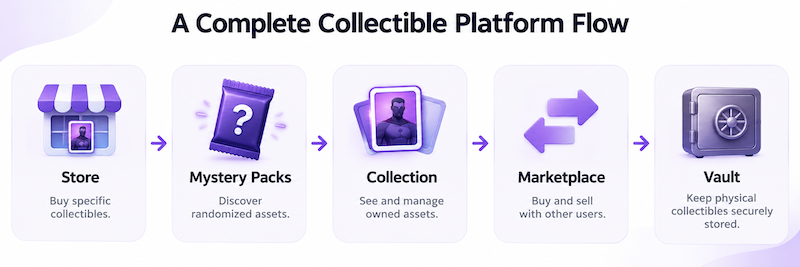
This creates a continuous customer journey instead of a single transaction.
And each layer makes the others more valuable. Mystery packs generate discovery. Collections give users a reason to return. The marketplace gives assets liquidity. The vault reduces friction for physical trading.
A collectible company does not necessarily need to replace its existing ecommerce business to build this model.
The digital layer can be added gradually.
A business might start with:
Existing inventory + digital collection
Then introduce: Mystery packs
And later add: User-to-user marketplace + digital ownership + vault integration
This is particularly relevant for businesses that already have valuable physical inventory, an established audience or specialist expertise in categories such as comics, trading cards or memorabilia.
The existing business remains the foundation.
The technology adds new ways for customers to discover, own and trade the same assets.
The most important question for a collectible business is not:
“Should we add gacha?”
It is:
“What happens to the asset after the customer receives it?”
If the answer is simply “it appears on the screen,” gacha remains a feature.
If the customer can collect the asset, prove ownership, trade it, resell it, keep the physical item in storage or eventually redeem it, the company is building something much larger.
It is creating a digital layer around its existing collectible business.
And mystery packs can be one of the mechanisms that brings users into that ecosystem.
Planning a digital collectibles platform?
We can help you build the infrastructure for mystery packs, digital ownership, marketplace flows, vault integrations and secondary trading.