
Sending money from one country to another usually involves several financial institutions. The payment may pass through banks, correspondent networks, foreign exchange providers, and local payment systems before the recipient receives the funds.
Stablecoins give payment companies another way to move value between countries. A company can accept fiat currency from the sender, convert it into a stablecoin, transfer the stablecoin over a blockchain network, and convert it into the currency required by the recipient.
The blockchain transfer is only one part of this process. A working cross-border payment also needs a way to move money into and out of stablecoins, manage wallets or accounts, perform compliance checks, access liquidity, and deliver funds through local payment methods.
In this article, we will look at how stablecoin cross-border payments work, which components are involved, how stablecoins can be used for remittances, and what businesses need to consider when building this type of payment product.
A stablecoin cross-border payment is a transfer between people or businesses in different countries where a stablecoin is used to move value during part or all of the transaction.
The sender and recipient do not always need to interact with stablecoins directly.
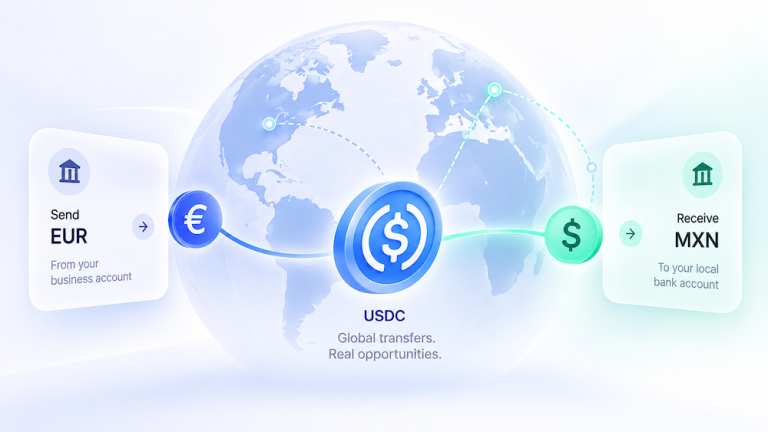
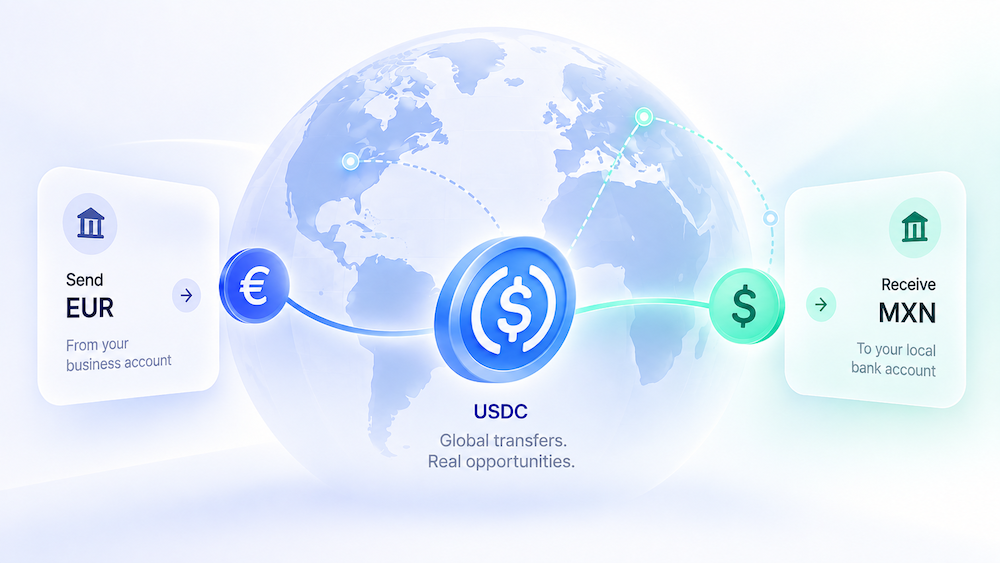
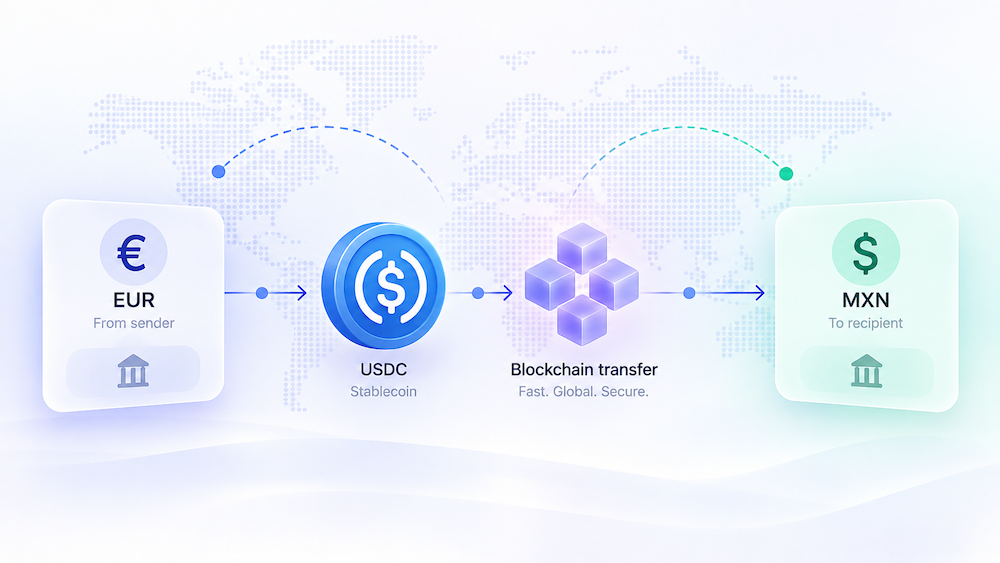
For example, a business in Germany may send EUR and a supplier in Mexico may receive MXN. Between these two points, the payment provider can convert EUR into USDC, transfer USDC over a blockchain network, and convert it into MXN.
EUR → USDC → blockchain transfer → MXN
The sender sees a payment in euros. The supplier receives Mexican pesos. The stablecoin works inside the payment infrastructure.
The Federal Reserve describes a similar model as a “stablecoin sandwich,” where fiat currency is converted into a US dollar stablecoin, transferred, and then converted back into local fiat currency at the destination.
Other models are also possible. The sender may already hold USDC, or the recipient may choose to receive the payment in a stablecoin instead of converting it into local currency.
The exact payment flow depends on the currencies, countries, providers, and product model. A fiat to fiat transaction using a stablecoin in the middle usually includes several steps.
The payment starts with the sender.
A business may fund the transaction through a bank transfer or another supported payment method. The system records the payment amount, recipient, currency, and other information required to process the transaction.
At this stage, the money is still fiat currency.
The next step is the on-ramp.
An on-ramp provider converts the sender’s fiat currency into a stablecoin such as USDC or USDT. The available stablecoins, currencies, payment methods, and countries depend on the providers used by the product.
Liquidity is important here. The product needs access to the required fiat and stablecoin pair at an acceptable exchange rate.
After conversion, the stablecoin can be transferred through a supported blockchain network.
The system needs a wallet or account from which the transaction can be initiated. It also needs transaction signing, address management, network fee management, and transaction monitoring.
The choice of network affects transaction costs, confirmation time, stablecoin availability, and integration requirements.
The on-chain transfer is part of a broader stablecoin payment rail. We explain the complete infrastructure behind these transactions in our guide to stablecoin payment rails.
If the recipient wants local currency, the stablecoin needs to be converted again.
An off-ramp or payment provider receives the stablecoin and converts it into the destination currency. This step requires local liquidity and access to the required banking or payment infrastructure.
EUR → USDC → USDC transfer → MXN
The USDC transfer may happen on-chain quickly, while the final delivery of MXN depends on the local payout method and provider.
The final step is the payout.
The recipient may receive money in a bank account, payment account, wallet, or another supported destination.
In some products, the recipient receives stablecoins directly. In others, the crypto part of the transaction remains completely invisible to both the sender and recipient.
A blockchain connection alone is not enough to build a cross-border payment product.
The payment flow usually connects several components. Wallet or account infrastructure manages transactions and access to stablecoins. On-ramp and off-ramp providers connect fiat currencies with the stablecoin layer. Liquidity providers support conversions, while payment and payout providers connect the product to local financial systems.
Compliance services may also be required for identity verification, transaction monitoring, sanctions screening, and other controls.
The product needs backend logic to coordinate these components and track the payment from initiation to completion.
ND Labs develops stablecoin payment infrastructure that connects the required product logic with wallets, blockchain networks, fiat rails, compliance services, and payout providers.
Settlement can mean different things depending on which part of the payment you are looking at.
The blockchain transaction may be confirmed when the stablecoin reaches the destination wallet.
However, this does not necessarily mean that the whole cross-border payment has finished.
If the recipient expects MXN in a bank account, the stablecoin still needs to be converted and the local payout needs to be completed.
This distinction matters when a product shows payment status to its users. Stablecoin received, conversion completed, and funds delivered to recipient can represent different stages of the same transaction.
Businesses also need records that connect the fiat payment, stablecoin transfer, conversion, fees, and final payout. This information is used for reconciliation and payment operations.
A remittance is a cross-border transfer that usually involves an individual sending money to another person, often a family member in another country.
Stablecoin remittances can follow the same general flow as other cross-border stablecoin payments.
GBP → USDC → blockchain → NGN
The sender pays in pounds. The payment provider converts the money into USDC and transfers it through a blockchain network. At the destination, USDC is converted into Nigerian naira and delivered using an available local payment method.
The recipient may never need to open a separate crypto wallet if an embedded wallet handles the blockchain layer inside the payment product.
Another model allows the recipient to receive the stablecoin directly. In this case, the recipient needs a compatible wallet and a way to use or convert the funds.
The practical result depends heavily on the last part of the transaction. Access to local currency, liquidity, and payout infrastructure can determine whether a stablecoin remittance is convenient for the recipient.
Access to local currency, liquidity, and payout infrastructure can determine whether a stablecoin remittance is convenient for the recipient. Stripe describes stablecoins as a practical option for cross-border payments and global payouts, while also pointing to the operational and risk requirements businesses need to manage.
Businesses can use the same infrastructure for supplier payments, contractor payments, treasury transfers, marketplace payouts, and other international transactions.
Consider a European company that needs to pay suppliers in several countries.
The company can fund payments in EUR. The payment system can convert the required amounts into stablecoins and use blockchain networks for the international transfer. At each destination, the funds can be converted into the local currency and sent through an available local payment method.
The same basic flow can support different business payment models.
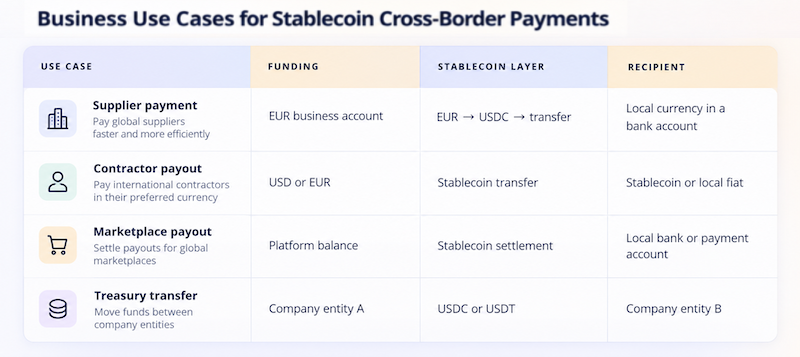
The business does not necessarily need to manage separate crypto transactions manually. Stablecoin functionality can operate inside the payment product while the user works with familiar accounts, currencies, recipients, and payment statuses.
The Federal Reserve has also identified cross-border payments as an area where the global nature of stablecoins may be useful, while noting that some existing frictions, including compliance requirements, remain necessary.
Using a stablecoin does not remove every problem involved in an international payment.
Fiat access. If users start or finish the transaction with traditional currency, the product needs reliable banking, on-ramp, and off-ramp connections.
FX. A USD stablecoin does not remove the need to exchange EUR into USD value or USD value into another local currency.
Liquidity. The required currencies and stablecoins need enough liquidity for conversion at both ends of the transaction.
Local payouts. Moving a stablecoin to the destination market does not deliver local currency to a bank account. The product still needs access to bank transfers or other payment methods available in that market.
Compliance. Cross-border products may need KYC, AML controls, sanctions screening, transaction monitoring, and other processes depending on the markets and business model.
Reconciliation. The system has to connect fiat deposits, blockchain transactions, conversions, fees, and payouts to the correct customer and payment.
The speed of an on-chain transaction should not be treated as the speed of the complete payment.
Visa also notes that the practical benefits of stablecoin cross-border payments depend on network, compliance, and off-ramp conditions.
The first step is to map the complete money flow.
The answers determine which providers and integrations the product needs.
A product that sends USDC between two business wallets has a different architecture from a service that accepts EUR and delivers BRL to a recipient’s bank account. Defining the flow first helps avoid adding infrastructure that the product does not need.
A cross-border stablecoin product usually combines infrastructure from several providers. One provider may handle fiat deposits, another may provide wallet or MPC infrastructure, and another may support local payouts.
The product layer connects these services into one payment flow.
It manages user and business accounts, payment instructions, transaction states, permissions, provider integrations, errors, fees, and operational data. It also determines what the user sees while the payment moves through different systems.
ND Labs builds this product and integration layer around selected stablecoin infrastructure. Our stablecoin payment infrastructure development work can include account functionality, transaction logic, payment and payout workflows, blockchain integrations, on and off-ramp integrations, compliance services, and backend systems.
Stablecoin cross-border payments are international transactions in which a stablecoin is used to transfer value between countries. The sender or recipient may use fiat currency while the stablecoin operates inside the payment flow.
Fiat currency can be converted into a stablecoin through an on-ramp, transferred over a blockchain network, and converted into another fiat currency through an off-ramp. Some transactions start or finish directly in stablecoins.
A stablecoin remittance is an international person-to-person transfer that uses a stablecoin during the payment process. The recipient may receive the stablecoin directly or receive local currency after conversion.
Yes. Stablecoins can be used as part of supplier payments, contractor payments, treasury transfers, marketplace payouts, and other B2B payment flows. The required infrastructure depends on the currencies, countries, settlement model, and payout methods.
Not always. A payment product can use wallets and stablecoins in the background while the recipient receives local currency in a bank or payment account. A compatible wallet is needed when the recipient receives and manages the stablecoin directly.
A cross-border stablecoin product can require wallet or account infrastructure, blockchain integrations, on-ramp and off-ramp providers, liquidity, compliance services, and local payment or payout integrations. The exact setup depends on where fiat enters and leaves the payment flow, which countries are supported, and how the recipient receives the funds.
Stablecoins give payment products another way to move value between countries. A transaction can start in fiat currency, use a stablecoin for the blockchain transfer, and finish in the local currency required by the recipient.
The complete payment still depends on the systems around that transfer. Wallets, liquidity, fiat conversion, compliance, local payment methods, and reconciliation all have a role in getting funds from the sender to the final recipient.
For a business building this type of product, the most useful starting point is the complete money flow. Once the currencies, countries, funding methods, stablecoin layer, and payout methods are defined, the required infrastructure becomes much easier to map.