A stablecoin payment rail can extend across blockchain, banking, conversion, and payout infrastructure. In a real payment product, value may need to enter from a bank account, convert into USDC, move on-chain, pass through transaction and compliance controls, and reach the recipient as either stablecoin or local currency.
The exact route changes from product to product. A payout platform may start with an existing USDC balance and finish with a bank transfer. A fintech app may accept EUR, use stablecoins inside the payment flow, and show only fiat balances to its users. Another product may keep both sides entirely on-chain.
What matters is that wallets, signing, conversion, blockchain networks, payout providers, transaction states, and reconciliation have to work as one payment flow.
This article breaks down that architecture: what belongs to the rail, what belongs to the product built around it, and what happens to a payment from initiation to final delivery.
A payment rail is the path used to move money between two parties.
In a stablecoin payment, part of this path runs through a blockchain network. A stablecoin such as USDC or USDT represents the value being transferred on-chain. Wallet infrastructure controls how the asset is held and transactions are signed. On-ramps and off-ramps connect the blockchain side of the flow with traditional currencies and banking systems.
These components can be combined in different ways.
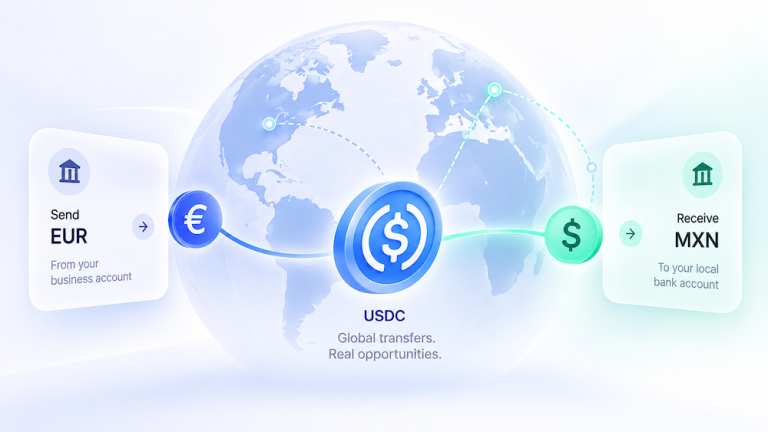
For instance, a company funds a payment in euros, the funds are converted into USDC, USDC moves over a blockchain network, and the recipient receives dollars in a bank account.
Cross-border stablecoin payment networks can follow this type of flow, with fiat entering through an originating institution, stablecoins moving on-chain, and a receiving institution converting the funds into local currency. Circle documents this architecture in its Circle Payments Network documentation.
For the sender and recipient, this may still look like a regular payment.
These terms describe different parts of the system.
Stablecoin is the digital asset used to represent value.
Blockchain is the network where the on-chain transaction is recorded and confirmed.
Payment rail is the path that connects the systems involved in moving the payment.
A payment product sits above this infrastructure. It gives users accounts, balances, payment screens, transaction history, permissions, notifications, and other functionality needed to use the underlying rails.

There is no single architecture for every stablecoin payment product. A platform that sends USDC payouts to contractors needs a different flow from a fintech product that lets customers deposit euros and withdraw dollars.
The components below appear in many payment architectures.
The account layer connects a person or business to balances and transactions inside the product.
Behind an account, there may be one wallet, several wallets, or an infrastructure provider that abstracts wallet management from the application. The product needs a way to create or assign addresses, read balances, initiate transactions, and control signing.
The custody model determines who controls the assets and signing process. A product may use custodial infrastructure, MPC-based infrastructure, a self-custodial model, or another setup that fits its requirements.
Users do not always need to interact with a traditional crypto wallet interface. A fintech application can show a familiar account with Deposit, Send, and Withdraw actions while the wallet layer works behind the product. Circle’s CPN documentation also notes that participating institutions may use Circle Wallets or their own wallet infrastructure, depending on their setup, as described in the Circle Payments Network documentation.
An on-ramp connects fiat money with digital assets.
Suppose a customer has EUR and needs to send USDC. The payment flow needs a provider or financial connection that can accept the fiat funds and make the required digital asset available for the transaction.
Coinbase documents fiat-to-crypto and reverse off-ramp flows in its Onramp & Offramp documentation.
The exact process depends on the provider, supported currencies, jurisdictions, payment methods, and account structure.
Some products need an on-ramp for every payment. Others already hold stablecoin balances and can start the flow directly from those funds.
The stablecoin is the asset transferred during the on-chain part of the payment.
The choice of asset affects the rest of the architecture. Teams need to consider which currencies the product supports, where the stablecoin is available, which networks can carry it, and whether the selected payment, payout, custody, and conversion providers support the same asset.
A product can also support more than one stablecoin. That adds routing and balance-management decisions to the backend.
The blockchain processes the on-chain transfer.
Networks differ in transaction costs, confirmation behavior, capacity, tooling, and stablecoin support. These differences can affect how the product handles transaction status, fees, retries, and the time at which funds become available for the next step in the payment flow.
The application needs a reliable way to read blockchain activity. Depending on the architecture, it may use blockchain APIs, node infrastructure, indexers, or services provided by another infrastructure partner.
A confirmed on-chain transaction is one event in the broader payment lifecycle. A product may still need additional provider confirmations, conversion, payout, internal ledger updates, or reconciliation before the business workflow is complete.
Settlement also needs to be defined carefully. CPMI and IOSCO distinguish technical settlement from legal settlement finality and recommend that stablecoin arrangements define when a transfer becomes irrevocable.
A blockchain transaction defines what should happen on-chain. The payment backend has to manage the business context around it.
It may need to know who created the payment, which account funds it, who can approve it, which recipient and network to use, what limits apply, and what status should be shown to the user.
B2B products can add another layer of rules. One employee may create a payment, another approve it, while other team members have view-only access.
The backend also needs to decide what happens when a payment stops halfway through the flow. A failed conversion, rejected transaction, or delayed payout should lead to a defined payment state and recovery path.
Compliance checks need defined places in the payment workflow.
Depending on the product, jurisdiction, providers, and operating model, these can include identity or business verification, sanctions screening, AML controls, address screening, and transaction monitoring.
A payment may enter a review state before signing, for example. Funds arriving from an external address may trigger another check. The backend then needs to know whether the payment can continue automatically, wait for review, or require an action from the operations team.
FATF discusses stablecoin-related illicit-finance risks and corresponding controls in its Targeted Report on Stablecoins and Unhosted Wallets.
The recipient may want fiat rather than a stablecoin. In that case, the payment continues beyond the blockchain transfer.
An off-ramp converts the digital asset into fiat, while a payout provider or banking connection delivers the funds through local payment infrastructure.
For example, a recipient in Poland may want PLN in a bank account. USDC can carry the value during the blockchain leg, followed by conversion and a local payout in PLN.
Circle documents this type of cross-border flow in its Circle Payments Network, where fiat can enter through an originating financial institution, USDC moves across a supported blockchain, and a beneficiary financial institution converts the stablecoin into local fiat.
The final fiat endpoint affects which corridors a product can support. Teams need to consider currencies, payout methods, provider coverage, liquidity, and account requirements alongside blockchain and stablecoin support.
A payment can pass through several systems before it is complete. Operations need to see those events as one payment rather than a collection of unrelated provider transactions.
For example, USDC may reach its destination successfully on-chain while the subsequent bank payout fails. The blockchain transaction is successful, but the customer-facing payment still needs attention.
The product therefore needs to connect payment status with relevant blockchain transactions, conversions, payouts, fees, provider responses, and compliance reviews. Operations should be able to see where the payment stopped and what can happen next.
Reconciliation brings those records together. An internal payment record can follow the lifecycle from payment creation through conversion, blockchain processing, payout, and completion.
This separation between the on-chain transaction and the wider payment lifecycle also appears in Circle’s CPN payment model and Fireblocks’ B2B stablecoin payments blueprint.
Consider a European company paying a contractor in USDC while funding the payment in EUR.
The payment starts in the product, where the company selects the recipient and amount. The backend checks account permissions, payment rules, and any required compliance conditions before funds move.
EUR is then converted into USDC through the connected on-ramp. The wallet layer prepares and signs the transaction, and USDC is transferred over the selected blockchain network.
Once the required transaction state is reached, the product updates its own payment record and the recipient’s balance. Conversion details, blockchain transaction data, fees, and payment status remain connected for reconciliation and operations.
In this case, the recipient keeps USDC. If the recipient wanted fiat, the flow would continue through an off-ramp and local payout provider.

The same infrastructure can support different money flows. The starting currency and the currency the recipient wants to receive determine which components are required.
Fiat → Stablecoin
EUR → USDC → Recipient wallet
Useful when the sender funds in fiat and the recipient wants stablecoins.
Stablecoin → Fiat
USDC → EUR → Recipient bank account
Useful for payouts where the sender already holds stablecoins.
Fiat → Stablecoin → Fiat
EUR → USDC → USD
The stablecoin works inside the payment flow while both endpoints remain in fiat.
Several problems appear when a payment moves across providers and systems.
A stablecoin may be available on several networks, while the selected custody, on-ramp, or payout provider supports only some of them. Currency and geographic coverage can narrow the available combinations further.
USDC can arrive successfully while the next conversion or bank payout fails. The product needs to represent that state correctly and give operations a way to resolve it.
The on-ramp, wallet provider, blockchain, and payout provider can all use their own transaction IDs and statuses. The backend needs a way to connect them to one customer-facing payment.
A provider may return statuses such as pending, broadcast, confirmed, or failed. Those states need to be translated into statuses that make sense inside the product and to its users.
Supporting USDC on a blockchain does not automatically create a EUR-to-PLN or USD-to-MXN payment corridor. Funding methods, liquidity, off-ramp coverage, banking connections, and local payout infrastructure still matter.
Before selecting providers or designing the integration architecture, teams need to define the payment flow itself:
Many components of a payment system are available from specialized infrastructure providers. Blockchain connectivity, custody, MPC signing, fiat ramps, identity verification, transaction monitoring, and payout services can be integrated into the product.
The application still needs its own structure around those services.
Accounts have to connect to the right wallets. Payment instructions need to become transactions. Provider responses need to update payment states. Permissions and business rules have to be enforced. Users and operations teams need a clear view of what is happening.
ND Labs builds the account, transaction, backend, and integration layers around selected stablecoin infrastructure. Our stablecoin payment infrastructure development work can start with an existing provider stack or with defining the required architecture during product discovery.
Stablecoin payment rails are the systems and connections used to move value between a payer and recipient with a stablecoin forming part of the payment flow. Depending on the product, the rail can involve wallets, blockchain networks, fiat on/off-ramps, payment or payout providers, compliance services, and settlement infrastructure.
A blockchain can provide the network used for the on-chain part of a stablecoin payment. A complete payment flow may also require wallet infrastructure, transaction logic, fiat conversion, compliance services, payouts, and reconciliation. The required components depend on where the payment starts and what the recipient needs to receive.
Users do not always need a traditional crypto wallet interface. A fintech or payment application can present accounts, balances, deposits, withdrawals, and payments while wallet infrastructure operates behind the product. The appropriate wallet and custody model depends on the application.
Yes. A payment flow can convert the sender’s fiat funds into a stablecoin, move the stablecoin over a blockchain network, and convert it back into fiat for the recipient. This requires suitable on-ramp, off-ramp, payment, and banking infrastructure for the currencies and markets involved.