
Agentic architecture is the system design that allows AI agents to plan tasks, use tools, access memory, coordinate workflows, request approval, and complete goals with controlled autonomy. It defines how an AI system moves from a user request to a real result: which agent acts, which tools it can use, what data it can access, or when it should stop.
Building a robust technical infrastructure is only half the battle. Before engineering the database models and LLM routing layers, the product team must define the boundaries of the underlying business logic. To see how to map these processes step-by-step, review our framework on blueprints and safety controls for AI agentic workflow automation.
If you are comparing agentic AI and generative AI, start with our guide to Agentic AI vs Generative AI. This article goes one layer deeper and explains how agentic systems are structured.
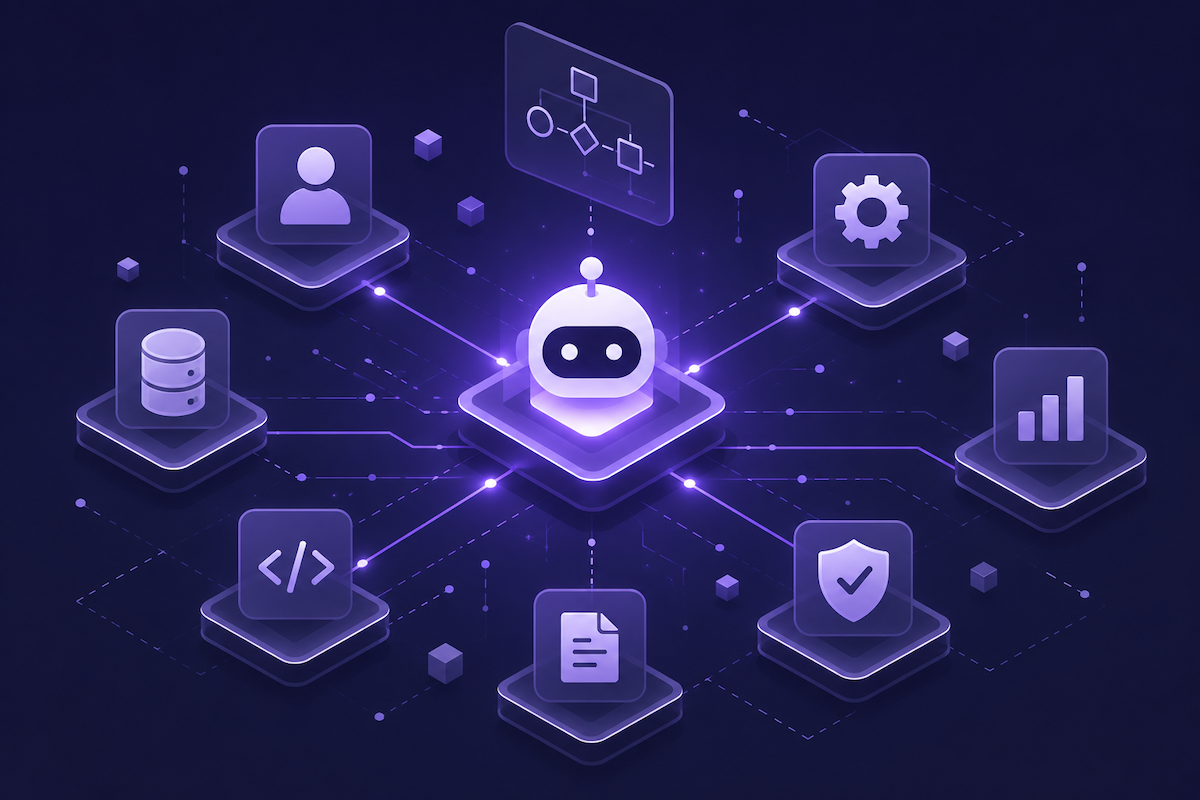
Agentic architecture is the structure behind AI agent systems. It connects the model, planning logic, memory, tools, agent roles, approval rules, and monitoring into one workflow. The goal is to help the system complete a task in a controlled way.
For example, an agentic system can review a smart contract audit, identify high-risk findings, compare them with an internal checklist, prepare a summary for developers, and flag issues that need manual review.
A well-designed agentic architecture usually includes:
Without these parts, an AI agent often becomes a chatbot with extra features.
Most companies need agents that can help with real work. In production, the answers to these questions matter because they define whether an agentic system is usable, safe, and reliable.
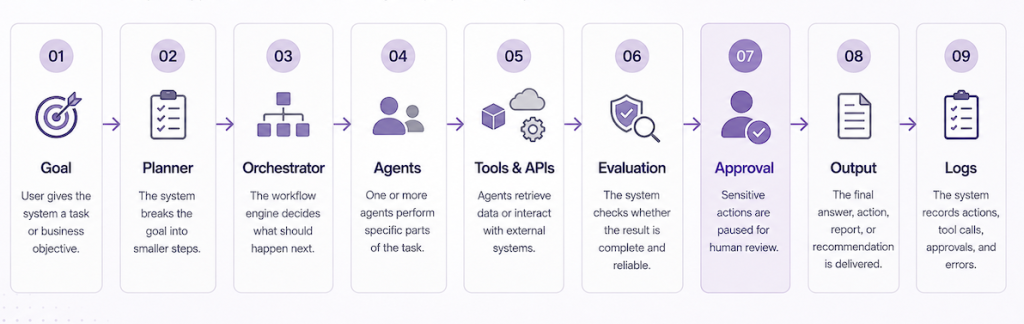
A simple way to understand agentic architecture is to look at the full path from request to result.
Goal → Planner → Orchestrator → Agents → Tools/APIs → Evaluation → Approval → Output → Logs
The goal is the user’s request. For example: “Check this wallet and tell me if there are any risk signals.” The planner breaks that goal into smaller steps. Different agents may research, execute, review, or explain the result. Tools and APIs connect the system to external data and actions, such as databases, CRMs, analytics tools, blockchain indexers, code repositories, or internal knowledge bases.
The evaluation layer checks whether the result is complete and reliable. If something is missing, the system can retry, use another source, or ask for human input. The approval step protects sensitive actions (sending money, changing account data, publishing content, or executing smart contract actions).
The output is the final result shown to the user or sent to another system. Logs record what happened, which tools were used, where data came from, and whether approval was requested.
This flow turns a simple AI interaction into a controlled system that can work in production.
These terms are often used together, but they describe different parts of the system.
An AI agent is the actor. It receives a goal, reasons about what to do, uses tools, and produces a result or performs an action.
An agentic workflow is the process. It is the sequence of steps the agent follows to complete a task.
Agentic architecture is the full system design. It connects agents, workflows, tools, memory, approval rules, monitoring, and logs.
Take a crypto wallet assistant as an example. The agent is the wallet risk assistant. The workflow is the process of checking wallet activity, reviewing token exposure, detecting suspicious contracts, and preparing a risk summary. The architecture includes the LLM, wallet data, blockchain indexer, risk scoring tool, planning logic, approval rules, and audit logs.
Many teams start by building an agent. In production, they quickly learn that the bigger challenge is the system around it.
A production-ready agentic system is built from several layers. Each layer has a clear role and affects the whole workflow.
The goal interpretation layer turns natural language into a structured task. Users often describe what they want in simple words. They may say, “Help me monitor wallet risk,” “Check this report,” or “Find what changed in our competitors’ pricing.” The system needs to understand the intent behind the request.
The LLM is often the reasoning and language layer of an agentic system. It can understand instructions, create plans, summarize results, explain decisions, and decide what step should come next.
The planning layer breaks a goal into steps before the system acts. Planning gives the agent a path. It also makes the workflow easier to monitor and improve.
An SEO agent should not start by writing recommendations. It first needs to review page structure, metadata, keywords, competitors, and content gaps. A wallet risk agent should not simply say whether something “looks risky.” It should check balances, approvals, smart contract interactions, and known risk signals before preparing a summary.
Memory helps the agent keep track of information during and across tasks.
Short-term memory keeps the current task context, such as which wallet address, document, or customer case is being reviewed. Long-term memory can store user preferences, previous decisions, or recurring instructions. External memory may include knowledge bases, vector databases, CRM records, internal documents, product data, or blockchain data.
Memory makes agentic systems more useful, but it also creates risk. Sensitive data should not be stored, reused, or exposed without clear rules. For a deeper look at permissions, memory risks, and guardrails, read our guide to Agentic AI Security.
Tools allow AI agents to work with external systems.
Without tools, an AI system can only answer based on the context it receives. With tools, it can search data, check records, create tickets, read analytics, review code, or inspect blockchain activity.
Common tools include:
Tool access is one of the main differences between a simple AI assistant and an agentic system. It is also one of the main sources of risk. A tool that reads data is not the same as a tool that changes data, sends money, or publishes content. The architecture should separate read-only access from action permissions.
The orchestration layer coordinates the workflow. It decides what happens first, which agent should act, which tool should be used, what context should move between steps, and when the system should stop.
In a single-agent system, orchestration may be simple. In a multi-agent system, it becomes central. One agent may research. Another may analyze. A third may review. A fourth may prepare the user-facing answer.
The goal is not to add more agents for the sake of it. More agents mean more coordination, more cost, and more things to debug. Separate roles make sense when one agent would have to switch between too many jobs at once.
An agentic system should check its own progress. After a tool call or intermediate result, the system needs to decide whether the goal has been met.
If a wallet risk agent checks only one data source and that source fails, the system should not present the result as complete. It should retry, use another source, or explain what is missing.
This layer reduces the risk of confident but incomplete results.
Some actions are safe to automate. Others are not.
Approval rules should be part of the architecture from the start. A practical rule works well for many products: the agent can prepare, explain, and recommend, but a human approves high-impact actions.
Logs should show the original request, the plan, tool calls, data sources, intermediate steps, approvals, errors, and final output. This matters for debugging, compliance, security reviews, and user trust.
Monitoring also helps teams improve the system over time. It can show where agents fail, which tools return weak data, and which workflows need better controls.
A generative AI system can write a product description. An agentic system can analyze product data, check competitor pages, create several description options, compare them with brand guidelines, prepare the final version, and send it for approval.
The model may be similar. The architecture is different. For a full comparison, read our guide to Agentic AI vs Generative AI.
Non-agentic AI responds to a prompt. It waits for input and returns an output.
Agentic AI can work toward a goal. It can plan steps, use tools, check results, and continue the workflow until the task is complete or approval is needed.
A non-agentic system can answer this request: “Summarize this smart contract audit.” An agentic system can handle a more complex task: “Review this smart contract audit, identify high-risk findings, compare them with our internal checklist.”
Agentic systems can be designed in different ways:
A single-agent architecture uses one agent to complete the task. It is often the best starting point because it is easier to build, easier to test, cheaper to run, and simpler to monitor.
Product companies should start with a single agent when the job has one clear owner: answer from a knowledge base, summarize a file, prepare a draft, check one data source, or handle a simple support request.
The limitation appears when the workflow grows. One agent may struggle if it has to research, analyze, use tools, review risk, and explain the final result at the same time.
A single-agent setup works best when the task is focused and the risk is low.
A multi-agent architecture uses several specialized agents. It makes sense when one agent would have to switch between too many jobs: research, execution, testing, review, documentation, and user communication.
A software development workflow may use one agent to suggest code, another to run tests, another to check security issues, and another to prepare documentation. A market research workflow may use one agent for competitor analysis, one for keyword research, one for pricing research, and one for final review.
Multi-agent systems are stronger when work can be divided, but they are weaker when orchestration is unclear.
A vertical architecture uses a leader or manager agent. The manager agent receives the goal, divides the work, assigns tasks, and collects results from other agents.
This setup is useful when someone, or something, must own the final decision: compliance review, financial reporting, approval workflows, or enterprise documentation.
For example, a compliance review system may use a manager agent to assign different checks: legal language, financial claims, missing information, and final summary. The manager agent then combines the results into one review.
The main weakness is the bottleneck. If the manager agent makes a poor decision, the whole workflow can move in the wrong direction.
A horizontal architecture uses agents as peers. There is no single leader. Agents can work in parallel, suggest different ideas, and compare results.
This model fits open-ended work where there is no single correct path at the start. Several agents can propose different product positioning ideas: one focused on customer pain points, another on competitors, another on technical features, and another on pricing logic.
Horizontal architecture is useful for brainstorming, research, product discovery, and creative strategy. The tradeoff is control. Peer agents can duplicate work, take longer to agree, or produce outputs that are hard to merge.
A hybrid architecture combines structure and collaboration. Some parts of the workflow may run in parallel, while other parts go through a manager agent, approval gate, or human review.
This is often the most realistic AI agent architecture for production.
A financial monitoring system, for example, may use several agents to analyze wallet activity, transaction history, and risk signals. But any action that affects funds must go through a manager agent and human approval.
Hybrid architecture is harder to design than a simple single-agent workflow, but it fits real products better when some actions are low-risk and others are sensitive.
Agentic architecture can also be described through reasoning models. These models explain how agents decide what to do.
Reactive agents respond directly to current input. They do not plan deeply. They map a situation to an action.
For example, an agent can tag support tickets based on keywords. If a message contains “refund,” it adds a billing label. If it contains “login,” it adds an account access label.
Reactive architecture is fast and works for simple automation. It is not enough for complex workflows that require planning, context, or judgment.
Deliberative agents reason before acting. They analyze the situation, create a plan, and then take action.
For example, an AI agent preparing a market research report should first decide which competitors to check, what data to collect, which sources to use, and how to structure the final report.
Deliberative architecture supports research, planning, analysis, and multi-step decisions. It is slower than reactive architecture, but it is better for tasks where the agent needs to think through the process.
Cognitive architecture tries to imitate parts of human thinking. It combines perception, memory, reasoning, learning, and adaptation.
For example, an enterprise assistant may learn how different teams ask questions, remember common workflows, use internal documents, and adapt its answers to company processes.
This type of architecture can support complex workflows, but it also needs stronger data governance, monitoring, and evaluation.
BDI stands for belief, desire, and intention.
Beliefs are what the agent knows. Desires are what the agent wants to achieve. Intentions are the actions the agent commits to.
A wallet risk assistant may reason in this way:
Belief: “The user’s wallet has exposure to a token with suspicious contract activity.”
Desire: “Help the user understand the risk.”
Intention: “Check token data, prepare a risk summary, and recommend next steps without making transactions automatically.”
BDI is useful because it makes agent behavior easier to explain. It connects context, goal, and action.
Building an agentic system for production is different from building a demo.
A demo can show that an agent can use a tool. A production system must define what happens when the tool fails, when the data is incomplete, when the user asks for a risky action, or when the output needs review.
These principles prevent many production problems. Most failures do not come from the model alone. They come from unclear permissions, missing logs, weak evaluation, or too much autonomy too early.
For a deeper breakdown of risks, permissions, and guardrails, read our guide to Agentic AI Security.
Choose a single-agent architecture when the task is narrow, the workflow is simple, the risk is low, and the agent needs only a few tools.
Choose a multi-agent architecture when the task requires several skills, parallel work is useful, or one agent should review another agent’s output.
Choose a vertical architecture when the workflow needs clear order, approval, accountability, or compliance review.
Choose a horizontal architecture when the task is exploratory and several possible answers should be compared.
Choose a hybrid architecture when the workflow has both structured and open-ended parts. This is often the case in financial products, Web3 systems, enterprise automation, and customer support at scale.
A practical rule is to start with the simplest structure that can handle the task safely. Do not build a multi-agent system if one well-designed agent is enough.
Agentic architecture becomes easier to understand when we look at workflow examples. The goal here is not to list every possible use case. It is to show how the architecture changes depending on the task.
For more business and Web3 scenarios, read our guide to Agentic AI Examples.
A wallet risk monitoring system may include wallet data, a blockchain indexer, a token risk tool, a transaction simulation tool, an agent, approval rules, and audit logs.
The agent can check wallet activity and prepare a risk summary. It can explain which tokens, approvals, or contracts may need attention. This workflow often fits a hybrid architecture. Agents can analyze data in parallel, while sensitive actions stay behind approval.
A customer support agent may use a user message, knowledge base, CRM, ticketing system, escalation rules, and human handoff.
For simple cases, one agent may be enough. It can answer questions, suggest help articles, and create a ticket. For more complex cases, a vertical structure may work better. A manager agent can classify the issue, assign it to a billing or technical support agent, and escalate the case if needed.
A software development agent system may include a codebase, issue tracker, code generation agent, testing agent, review agent, CI/CD tools, and human approval before merge.
One agent may propose a code change. Another may run tests. Another may check for security issues. A developer reviews the final pull request before it is merged. This workflow is usually multi-agent or vertical.
Agentic architecture is the system design that enables AI agents to understand goals, plan tasks, use tools, access memory, coordinate workflows, and complete tasks with controlled autonomy.
No. Agentic AI is the broader idea of AI systems that can act toward goals. Agentic architecture is the structure that makes this behavior possible.
They are closely related, but not always identical. AI agent architecture often describes how one agent is designed, including its model, tools, memory, and task logic. Agentic architecture usually describes the broader system around one or many agents, including workflows, orchestration, approval rules, monitoring, and logs.
An AI agent is the actor. Agentic architecture is the full system around the agent, including planning, tools, memory, orchestration, approvals, and monitoring.
The main components are the reasoning model, goal interpretation, planning, memory, tools, orchestration, agent roles, evaluation, approval controls, and monitoring.
The main types include single-agent architecture, multi-agent architecture, vertical architecture, horizontal architecture, and hybrid architecture. Some systems also use reasoning models such as reactive, deliberative, cognitive, or BDI architecture.
There is no single best type. A single-agent architecture works well for simple tasks. Multi-agent and hybrid architectures are better for complex workflows that need specialization, review, or controlled action.
Yes, for high-risk workflows. Human approval is important for payments, financial decisions, legal actions, healthcare-related workflows, account changes, publishing, and smart contract interactions.
Agentic architecture is what turns AI from a prompt-response tool into a controlled workflow system.
The right architecture depends on the task. Some products need one simple agent. Others need several specialized agents, a manager agent, or a hybrid structure with approval gates.
ND Labs helps companies design and develop production-ready AI agent systems for Web3 and blockchain products. Learn more about our AI agent development services.