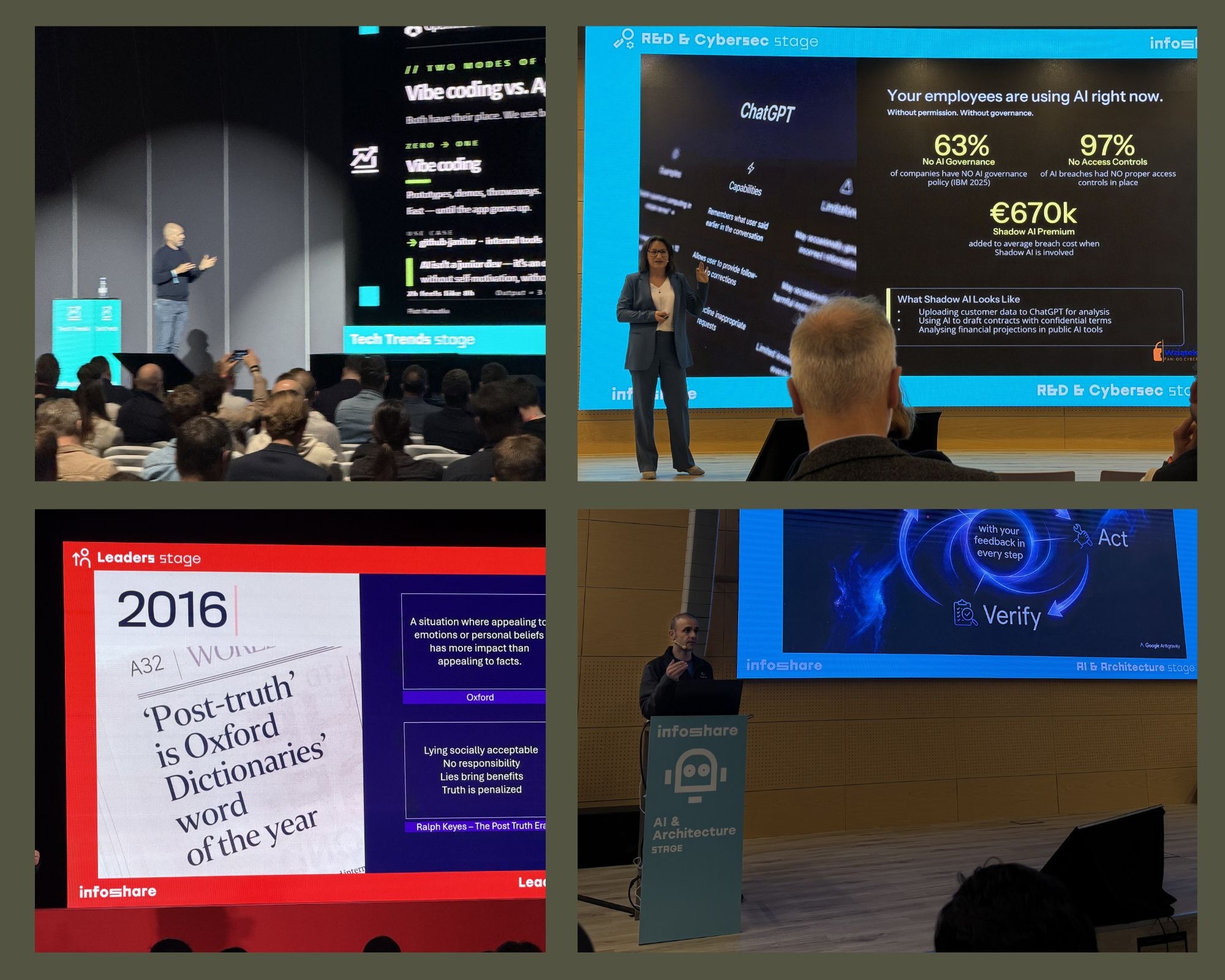

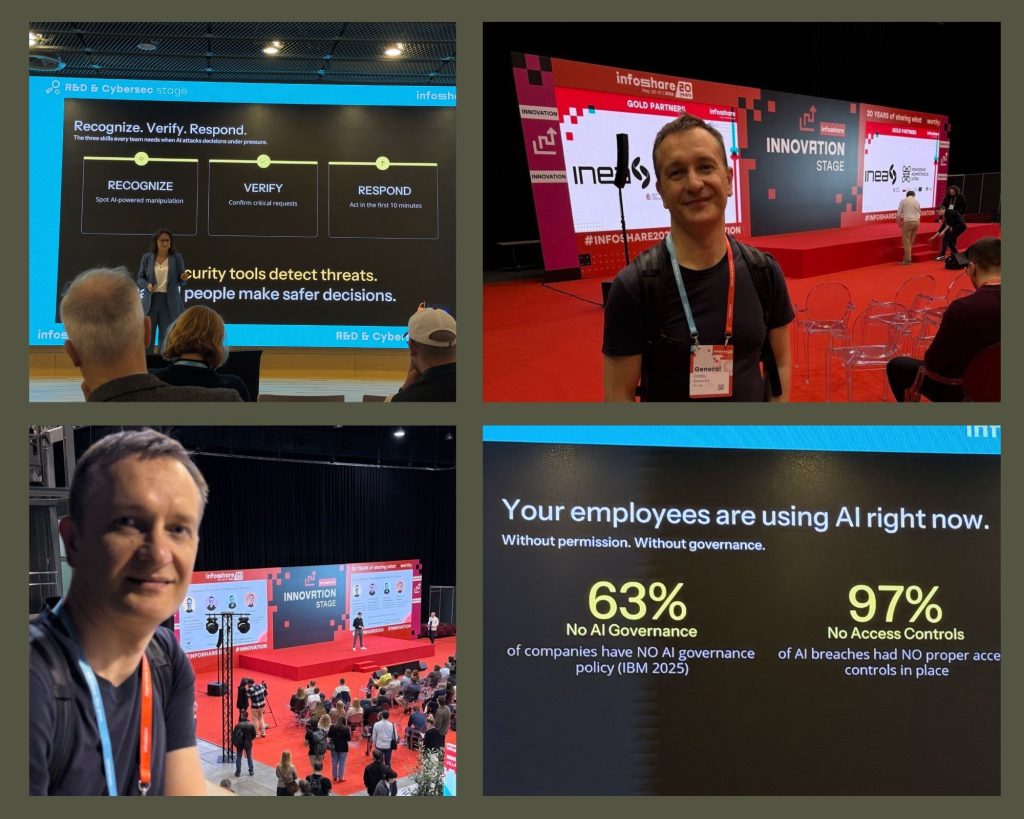
At the Infoshare conference, one thing became clear: AI is no longer just a topic for innovation panels, experimental demos, or future-looking discussions.
As a Community Partner of Infoshare 2026, ND Labs was glad to support a conference that brings together technology leaders, founders, engineers, investors, and companies shaping the future of digital products.
After attending the event, ND Labs’ CEO Dmitriy Khanevich noted that AI was not treated as a separate innovation track anymore. It appeared across infrastructure, cybersecurity, product development, and business strategy discussions, which is a clear signal for Web3 founders building the next generation of digital products.
The conversation is moving from “How can we use AI?” to a much more important question: How can we integrate AI safely, reliably, and meaningfully into real products?
One of the strongest signals from Infoshare was that AI is moving deeper into the infrastructure layer.
Behind every simple AI-powered API, there is a complex technical reality: GPUs, latency, cold starts, routing, inference costs, model availability, and scalability. For users, AI often looks like a simple interface. For product teams, it is a system that needs architecture, cost control, reliability, and performance planning.
This is especially important for Web3 founders.
Web3 products already operate in environments where performance, trust, and security matter. Wallets, DeFi platforms, RWA solutions, analytics tools, DAO infrastructure, and decentralized applications cannot treat AI as a simple plug-in.
If AI becomes part of the user experience, the product team must answer critical questions:
This is also why AI-augmented Web3 development is becoming more relevant for founders: AI can speed up product delivery, but only when it is supported by strong architecture, testing, and security practices.
Another important takeaway from Infoshare was the complexity of testing AI systems, especially AI agents.
Traditional software testing is usually based on expected outputs. If the system receives a specific input, it should return a predictable result. But AI agents do not always work this way. Even with low temperature settings, outputs can vary because of model behavior, prompt structure, infrastructure changes, context, and external data.
For Web3 products, this is a major issue.
If an AI agent summarizes blockchain data, supports user onboarding, explains smart contract risks, assists with trading decisions, or automates workflows, the team cannot rely on “it worked once” as proof of quality.
AI-powered features need a different quality assurance approach:
This is where AI integration becomes a product maturity question. For founders exploring AI agent development for Web3, testing becomes one of the most important parts of product reliability.
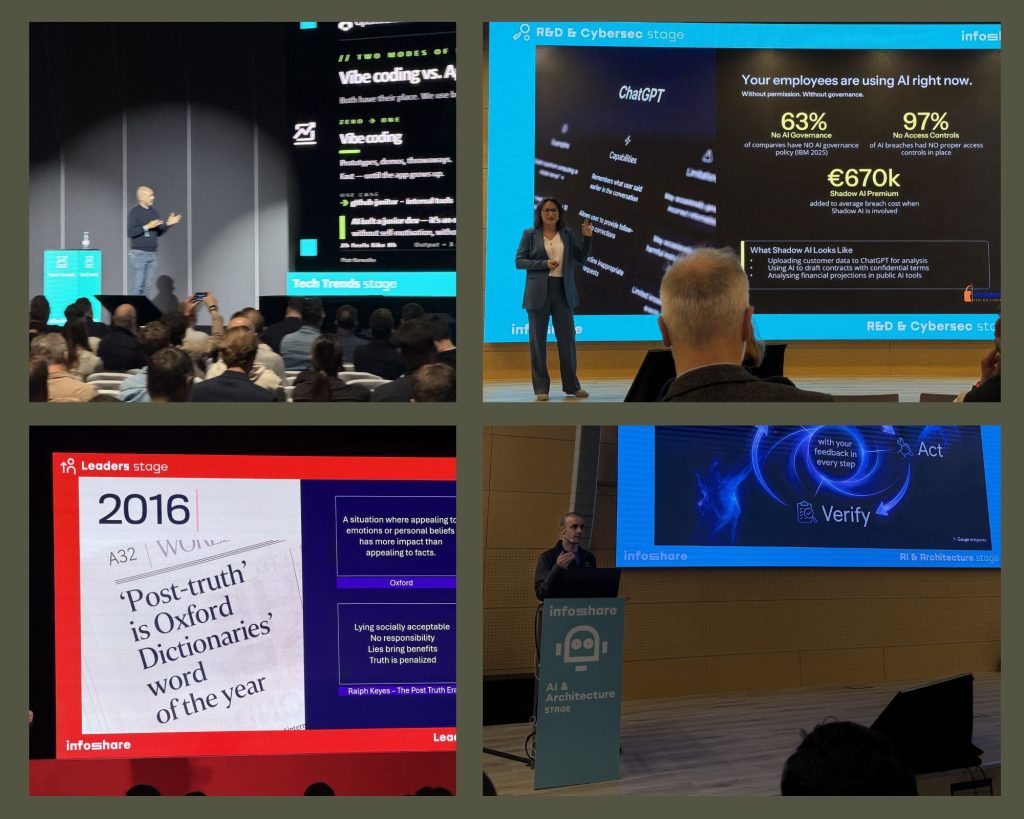
Cybersecurity was another major theme at Infoshare, and the AI angle was especially relevant for founders.
AI is changing how attacks are created, scaled, and delivered. Voice cloning, deepfake video calls, AI-generated phishing, fake approvals, and social engineering are becoming more convincing.
The key message was simple:
For Web3 startups, the risk is even higher. The industry already faces phishing, fake wallet support, malicious links, fraudulent token campaigns, impersonation, and social engineering. AI makes these attacks faster, cheaper, and more believable. We covered some of these risks in our guide about nft scams.
This means security cannot sit only in the technical layer.
Founders need verification protocols for sensitive decisions:
AI-powered cybersecurity threats attack trust. They exploit speed, pressure, and human assumptions.
That is why AI integration and Web3 security need to be considered together.
AI can also create risks from inside the company.
Employees may use public AI tools to speed up work: summarize documents, review code, write reports, analyze contracts, or prepare client communication. In many cases, the intention is positive. The risk comes from the lack of rules.
Sensitive information can leave the company through helpful employees, not malicious insiders.
For Web3 startups, this may include:
This is why AI governance should not be postponed until the company becomes large.
Even early-stage startups need clear rules:
AI integration without governance can create hidden operational and security risks.
One of the broader conversations at Infoshare focused on trust, shared facts, and the post-truth environment.
This may sound philosophical, but it is highly relevant for Web3 founders.
Web3 was built around the idea of verification. Blockchain technology introduced new ways to verify transactions, ownership, provenance, and digital assets. But AI adds a new layer of complexity.
In an AI-driven environment, users need to verify not only transactions, but also:
If voice, video, text, and images can be generated or manipulated, trust can no longer rely on appearance. It must be designed into the product.
For Web3 teams, this creates an opportunity.
The combination of AI and Web3 can help build products where automation is powerful, but verification remains transparent. AI can improve user experience, simplify complex workflows, and support decision-making. Web3 can provide auditability, ownership, identity layers, and trust mechanisms.
The strongest products will not be the ones that use AI for the sake of using AI.
They will be the ones that combine AI with clear verification, strong security, and real user value.
For Web3 founders, the message from Infoshare is clear: AI is no longer just an experimental layer. It is becoming part of how digital products are built, secured, scaled, and trusted. For early-stage teams, this also changes how MVPs are planned. AI can help founders validate ideas faster, automate workflows, and improve product experience from the first version. We explored this in more detail in our article on how AI can support MVP development.
Before integrating AI into a Web3 product, founders should consider 5 questions:
1. What real user problem does AI solve?
AI should reduce friction, improve decisions, automate complexity, or create a better product experience.
2. Is the architecture ready for AI at scale?
Latency, cost, infrastructure, and reliability matter from the beginning.
3. How will AI outputs be tested?
Non-deterministic systems require benchmarks, monitoring, and quality thresholds.
4. What are the security risks?
AI can increase the risk of phishing, impersonation, fake approvals, and data leakage.
5. How will trust be preserved?
Users need clarity, verification, and control when AI becomes part of the product flow.
The first wave of AI adoption was driven by curiosity and speed.
The next wave will be driven by integration quality.
For Web3 startups, this is an important moment. AI can make products more intelligent, accessible, and efficient. But it also introduces new technical, security, and trust challenges.
The companies that win will not be the ones that add AI as a marketing feature.
They will be the ones that integrate AI into the product thoughtfully — with the right architecture, testing, governance, and security mindset.
At ND Labs, we help Web3 startups move from ideas to secure, scalable digital products. As AI becomes a bigger part of the Web3 ecosystem, our focus is on helping founders integrate AI in ways that create real product value while protecting trust, data, and users.