
When implementing artificial intelligence, Web3 companies often ask the wrong question: “Which model should we choose?” At ND Labs, we believe the ultimate question should be: “Which specific business workflow can an AI agent safely support?”
The agent is not the product; the workflow is. This is why successful AI deployment doesn’t start with building a generic, sci-fi “AI assistant.” Instead, it begins with one focused product process that is easy to map, test, monitor, and scale. If you are still exploring the core differences between basic prompts and fully autonomous systems, start with our deep dive into Agentic AI vs Generative AI.
This guide focuses entirely on the practical layer: how to design a safe, highly-optimized AI agentic workflow tailored for the unique challenges of the Web3 ecosystem.
AI agentic workflow automation means using specialized autonomous software to execute multi-step, complex processes inside a digital product. Unlike traditional automation (like Zapier or rigid RPA scripts) that simply moves data from point A to point B using strict “if-this-then-that” rules, an agentic workflow introduces reasoning, context evaluation, and dynamic tool selection at every turn.
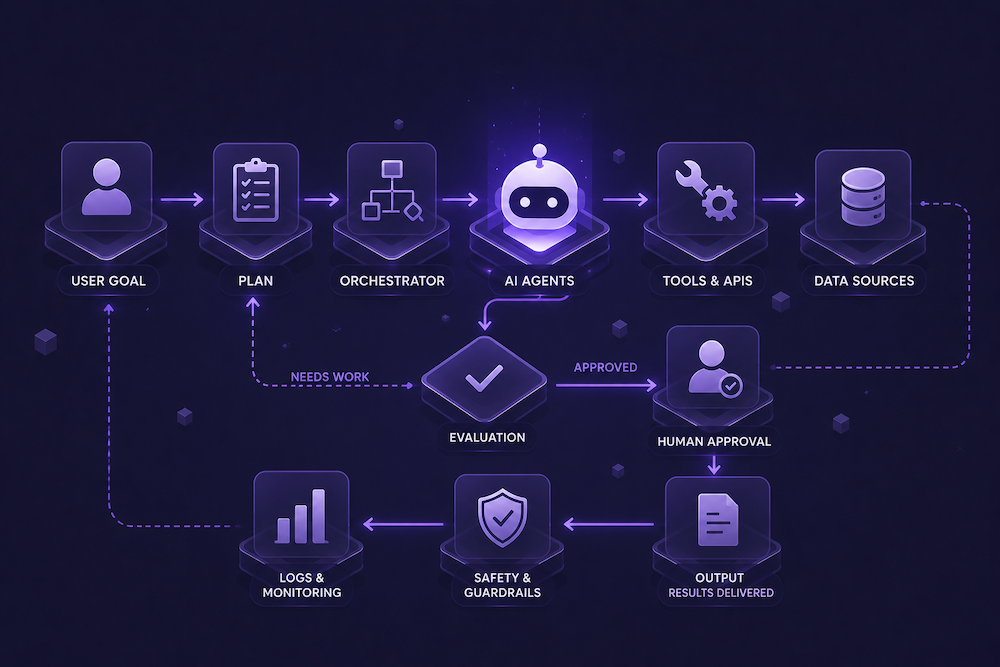
A resilient agentic workflow follows a strict, traceable path engineered into the system:
Trigger → Inputs → AI Reasoning Loop → Tool Execution → Verification → Human-in-the-Loop Approval → Output & Logs
The core philosophy behind this design is predictability. By structuring the workflow layer correctly, we define exactly what data the agent can read, which smart contracts it can analyze, and precisely where the system must pause to wait for human verification.
To avoid unnecessary risks, especially when handling on-chain data, we categorize agentic workflows into four distinct tiers. For Web3 applications, we heavily advise starting with lower-risk tiers before unlocking fully autonomous capabilities.
| Workflow Type | Agent Capabilities | Web3 Enterprise Example | Risk Level |
|---|---|---|---|
| Read-Only | Observes logs, parses data, and summarizes insights. | Active wallet token approvals risk scoring. | Low |
| Assisted | Recommends strategies, warns of anomalies, drafts actions. | DeFi portfolio yield optimization suggestions. | Medium |
| Action-Ready | Prepares full cryptographic payloads, waiting for signature. | Compiling a batch transaction to revoke a compromised contract. | High |
| Autonomous | Executes on-chain/off-chain steps within rigid caps. | Micro-budget gas fee hedging or internal node recycling. | Critical |
If your developers, analysts, or power users spend hours jumping between Etherscan, Snapshot governance portals, Dune Analytics dashboards, Discord announcement logs, and Telegram alpha channels just to make a single strategic move, your team is paying a massive operational tax. An AI agent acts as an automated data aggregator that digests these unstructured sources simultaneously, processing multi-chain data in seconds.
Traditional software bots are rigid: they only monitor hard-coded thresholds (e.g., “Ping Slack if gas token costs exceed 60 Gwei”). They completely fail when an incident requires contextual investigation. If a DeFi liquidity pool suffers a sudden capital drain, an agentic workflow doesn’t just send a generic alert. It reads the raw smart contract transaction logs, traces the exploiter’s address back to initial funding sources (like Tornado Cash), extracts real-time sentiment from X security accounts, and drafts an immediate incident report for your core engineering team.
Web3 protocols often run incredibly lean operations, yet their global user base demands 24/7 technical oversight. When a user runs into a complex issue, generic AI chatbots fail. An agentic workflow trained on technical documentation, past security audits, and whitepapers can actively debug a user’s failed transaction hash on-chain, explaining in plain language: “Your swap failed because your slippage tolerance was set too low for this volatile liquidity pool.”
For a broader view of how these behaviors manifest across industries, you can explore our curated index of Agentic AI Examples.
To implement an AI agentic workflow successfully, you must outline the business logic step-by-step before engineering the technical system around it. Below are four blueprint structures designed by ND Labs.
Hidden token permissions are one of the biggest vulnerabilities on-chain. This workflow makes exposure visible without compromising private keys.
DAO participants struggle with cognitive fatigue caused by long-form, poorly structured on-chain proposals.
AI should never replace human security firms, but an automated workflow can optimize internal code reviews before entering expensive formal audits.
In decentralized environments, code bugs are final and mistakes can be financially devastating. If your company is deploying agentic automation, security guardrails must be implemented directly at the system-level layer. For a granular look at how we build these data environments, read our comprehensive guide on Agentic AI Architecture.
Every industrial-grade workflow requires these four fundamental seatbelts:
Designing a safe, reliable, and production-ready AI workflow requires a deep understanding of both LLM orchestration and Web3 data structures. At ND Labs, we specialize in building enterprise-grade, secure AI agents tailored for your specific business requirements.Explore Our AI Development Services