
In Web3, a user may need to understand wallet activity, token risk, gas fees, smart contract warnings, bridge options, DeFi positions, or DAO proposals. They involve live data, user assets, contracts, and security decisions. And an AI agent should help users understand what is happening, prepare the next step, warn them about risk, and keep the final decision in human hands.
These agentic AI examples show how AI agents can support real workflows. The focus here is Web3, DeFi, wallets, DAOs, smart contracts, and business operations.
Some examples below describe current ND Labs product direction. Others show practical Web3 agentic AI workflows that teams can design around the principles: trusted data, tool access, human approval, and guardrails.
If you are still comparing agentic AI with generative AI, start with our guide to agentic AI vs generative AI.

Web3 agentic AI is still earlier than enterprise agentic AI, but real examples are already emerging. They show the same pattern: agents need trusted data, tool access, validation, limits, and observability. In Web3, those controls matter even more because agents may work near real capital.
These examples show that Web3 agentic AI is no longer only a concept. It is already appearing in on-chain trading, agentic payments, DAO governance, creative communities, and smart contract security.
For most Web3 startups, the most practical entry point is not a fully autonomous trading agent. It is an AI-assisted wallet.
A wallet is where the user already makes decisions: checking balances, reviewing tokens, preparing swaps, bridging assets, approving contracts, monitoring DeFi positions, and signing transactions. An AI assistant can support these moments without taking control away from the user.
Next, let’s look at the practical agentic AI use cases that matter most for Web3 products: AI-assisted wallets, DeFi monitoring, swaps, cross-chain routing, DAO governance, and smart contract security.
Most wallets show users data. They do not always help users understand what that data means.
A user may see token balances, transaction history, gas fees, bridge options, contract warnings, DeFi positions, and price changes. That is a lot to process. For experienced users, it is manageable. For new users, it can be confusing and risky.
This is where an AI assistant can help.
These examples become safer and more useful when they are built on the right agentic AI architecture for Web3: clear planning, controlled tool access, risk checks, approval layers, and audit logs. This is also the direction ND Labs is taking with its Web3 wallet with an AI assistant. The wallet is ready, and the team is now adding an agent layer to help users move through Web3 workflows with more context and control.
What the agent can do
The wallet assistant can support:
A user may ask: “Why did my portfolio drop today?”
The agent can check token prices, wallet balance, transaction history, DeFi positions, and relevant market news. Then it can explain what changed.
Another user may ask: “Can I swap this token safely?”
The agent can check token data, DEX liquidity, contract risk signals, price impact, estimated gas, and possible warnings. It can prepare the action, but the user still signs.
A wallet AI assistant may use:
This is what makes it more than a content assistant. It is not just explaining Web3 terms. It is reading wallet context and preparing the next step.
For wallet agents, safety matters more than speed. The ND Labs wallet assistant follows a safety-first design:
The agent can explain, prepare, and warn. The user stays in control.

DeFi users often manage positions across several protocols. They may track staking, liquidity pools, lending positions, yield strategies, collateral ratios, and token exposure.
Doing this manually takes time. It also creates risk. A user may miss a change in APY, volatility, liquidation risk, or protocol health.
A DeFi position monitoring agent can watch these signals for the user.
For example, the agent can monitor pool liquidity, APY or APR changes, collateral ratios, token volatility, smart contract events, protocol announcements, risk scores, gas costs, and market changes. It can then alert the user if something needs attention.
The agent reads live data, checks it against risk rules, and prepares a recommendation. It may say:
“Your position in Pool A now has higher volatility and lower liquidity. Consider reviewing it before adding more funds.”
The value is simple: less manual monitoring, faster risk detection, and better user awareness.
For wallets and DeFi platforms, this can also create better retention. Users are more likely to stay active when they understand what is happening with their positions.
Swapping tokens looks simple from the outside. In practice, a user has to consider price impact, liquidity, slippage, gas fees, token risk, and contract safety.
A swap preparation agent helps the user compare options before acting.
The user says: “Prepare a swap from Token A to Token B.”
The agent can check available DEX routes, expected output, slippage, liquidity, gas fees, token contract risk, price movement, recent suspicious activity, and whether the token is known or risky. Then it prepares the safest available route under the user’s settings.
Business value: For wallet users, this reduces confusion. For wallet providers, it can reduce failed swaps, support tickets, and user frustration.
Cross-chain actions are one of the hardest parts of Web3 UX.
A user may need to move assets from one chain to another. They have to choose a bridge, check fees, estimate time, understand risks, and make sure the destination chain supports the asset.
A cross-chain route suggestion agent can help with that. The user sets a goal: “Move USDC from Chain A to Chain B with low fees and reasonable safety.”
The agent compares available routes. It checks fees, bridge history, speed, liquidity, supported assets, recent incidents, and contract risk. Then it suggests one or more routes.
It can also warn the user if the cheapest route looks risky.
Business value: Users get fewer routing mistakes. Wallets can offer a smoother cross-chain experience without hiding risk.
The best agent does not say, “This is the cheapest route.” It says, “Here are your options, here are the trade-offs, and here is what you need to approve.”
Many Web3 users do not know when a contract interaction is dangerous.
They may click a phishing link, approve a malicious spender, interact with a fake token, or sign a transaction they do not understand. A scam warning agent can add a safety layer before the user acts.
Before a user signs, the agent checks the transaction context. It can look at contract address, token approval request, spender permissions, transaction method, known scam indicators, suspicious domain or app behavior, user’s previous interactions, contract verification status, and risk API signals.
Then it gives a warning: “This transaction asks for unlimited approval to move your tokens. The contract is not on the allowlist. Review before signing.”
Business value: This can reduce user losses, improve wallet trust, and lower support pressure after scam incidents.
It also gives Web3 products a stronger safety story without taking custody away from the user.
DAO members often face long proposals, forum debates, treasury numbers, and technical execution details.
Many proposals are too long for casual voters. Some include smart contract actions. Some affect treasury funds. Some change protocol rules.
A DAO governance agent can help members review proposals faster. The agent can summarize proposal text, identify requested budget, check treasury impact, compare the proposal with DAO rules, flag missing information, review voting history, explain execution payloads, and prepare a voting recommendation.
Business value: DAO voters save time. Delegates get better summaries. Treasury risks become easier to spot before the vote.
The agent can monitor unusual admin calls, ownership changes, repeated failed transactions, sudden withdrawals, oracle updates, pause or unpause events, abnormal contract interactions, suspicious spikes in volume, and unexpected function calls.
When something looks wrong, it alerts the team and explains why.
The main business value is speed. A good monitoring agent can reduce detection time and help security teams react earlier. It also gives teams a clearer record of what happened.
Wallets, DeFi apps, exchanges, and fintech platforms may need to detect suspicious wallet behavior.
The agent may look for rapid fund movement, suspicious wallet clustering, interaction with risky contracts, unusual deposit and withdrawal patterns, mixer exposure signals, bridge activity, blacklist or sanctions provider signals if the platform uses them, repeated failed attempts, and abnormal transaction timing.
Business value: The agent can reduce review time and help teams focus on high-risk cases.
DAO and startup treasuries can carry serious risk.
A treasury may be too concentrated in one token. It may hold assets with low liquidity. It may miss a stablecoin depeg warning. It may have upcoming expenses that are not matched by liquid assets.
The agent tracks treasury composition and risk signals. It can monitor asset concentration, market volatility, stablecoin risk, liquidity depth, token unlocks, treasury inflows and outflows, DeFi exposure, upcoming payment obligations, and DAO spending proposals.
Then it can recommend a review or prepare a treasury report.
The business value is better visibility. Treasury teams get faster alerts, clearer reports, and less manual spreadsheet work. DAO members get more context before voting on spending.
Many Web3 teams have long technical docs. Developers need answers fast, but documentation can be hard to search.
A basic RAG assistant can answer questions from verified docs. To make it more agentic, it should do more than answer. The agent may use protocol docs, smart contract ABIs, GitHub repositories, changelogs, API references, support tickets, version history, and internal technical notes.
Business value: Developer teams get fewer repeated questions. Users find answers faster. Product teams see which docs need improvement.
The agent can review pull requests, scan smart contract code, check for common vulnerability patterns, compare changes against internal rules, flag risky functions, explain why a change needs review, and create a security checklist for auditors.
Business value: The agent can catch issues earlier in the development cycle. It can also help auditors focus on the most suspicious parts of a change.
The agent can monitor tokenized asset performance, issuer reports, NAV updates, distribution schedules, missing documents, changes in on-chain state, discrepancies between off-chain reports and on-chain data, and late payments or delayed updates.
It can alert the operations team when something needs review.
Business value is operational visibility. Teams can find gaps earlier, reduce manual reporting work, and create a clearer audit trail.
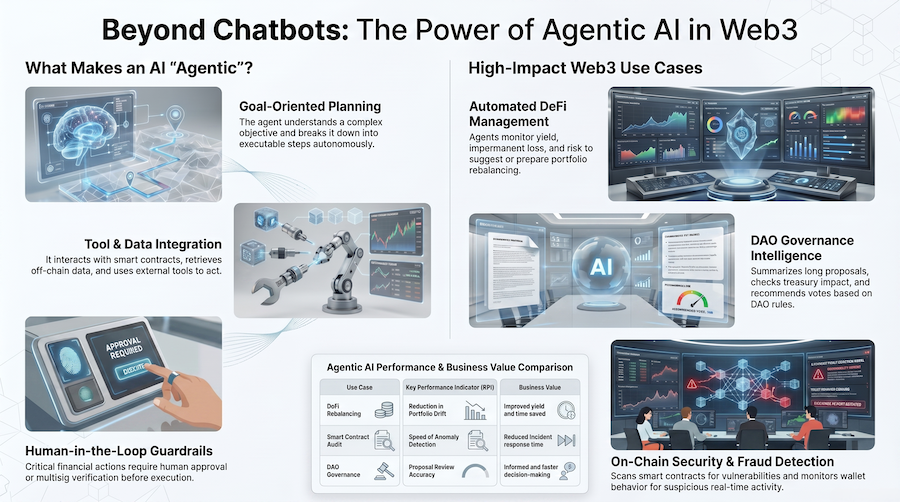
Web3 is one of the clearest areas for agentic AI because many workflows already depend on live data, rules, transactions, and transparent on-chain activity.
But the same pattern also applies in other industries.
The strongest use cases have the same pattern: clear data, repeatable workflow, tool access, measurable result, and a safe approval path.
For example:
If the task happens once a year, an agent may be overkill.
2. Agentic AI needs data it can read.
For Web3, that may include wallet balance, token prices, transaction history, contract events, protocol docs, DEX data, or risk APIs.
3. The agent needs boundaries.
For example:
If the rules are vague, the workflow is not ready.
4. The action can be reviewed. This is especially important in Web3.
5. The result is measurable
Good metrics include:
Agentic AI sounds exciting because it can act. But some actions should never be fully automated without strong controls:
Transaction signing. The user should stay in control of signing. A wallet agent may prepare a transaction, explain it, warn about risk, and estimate gas. The final signature should stay with the user.
High-value fund movement. Any high-value transfer should require approval. For teams and DAOs, that often means multisig.
New contract interactions. Agents should be cautious with unknown contracts. Contract allowlists and warnings can reduce exposure.
DAO votes. A governance agent can summarize, analyze, and recommend. Voting should stay with the voter or delegate unless there is a strict, pre-approved policy.
Smart contract upgrades. Upgrades can affect an entire protocol. AI can support review, but humans should approve final execution.
Compliance actions. Fraud and risk agents can flag cases. Enforcement decisions need process, review, and documentation.
Seeing high-level use cases across industries helps visualize the power of autonomous software. However, turning an idea into a functional product requires mapping the exact triggers, inputs, and human-in-the-loop handoff points. Explore our practical deep dive into designing a production-ready AI agentic workflow to see how these examples are built in practice.
A user opens a crypto wallet because they want to check assets, make a decision, move funds, swap tokens, bridge assets, claim rewards, or review a transaction.
The assistant AI can work in the moment when the user needs context.
Instead of sending users to external tools, docs, explorers, and dashboards, the wallet can bring the information into one guided flow.
For a crypto wallet, this creates another benefit: teams can add AI-assisted Web3 UX without building the entire wallet and agent system from scratch.
The product keeps its brand. The assistant supports the user behind the scenes.
A strong wallet AI assistant should be useful in high-friction moments:
These are the moments where users need help.
If you are planning a Web3 product with AI-assisted actions, we can help you design the wallet logic, agent workflow, and safety controls. Book a call
Examples of agentic AI include wallet assistants, DeFi monitoring agents, DAO proposal agents, smart contract monitoring agents, fraud detection agents, treasury risk agents, and support agents that use tools to complete workflows. A real agentic AI system does more than answer a prompt. It works toward a goal, uses data and tools, and follows rules.
Agentic AI is an AI system that can pursue a goal by planning steps, using tools, retrieving context, making decisions, and taking or preparing actions. For example, a wallet AI agent can explain portfolio changes, check transaction risk, prepare a swap, and ask the user to approve the final action.
A strong Web3 example is a wallet AI assistant. It can read wallet balance, transaction history, token prices, DEX data, protocol docs, and risk signals. Then it can explain activity, prepare actions, warn about suspicious contracts, and keep the final signature with the user.
A chatbot usually answers a question. An agentic AI system can move through a workflow. It may retrieve data, use tools, compare options, prepare an action, ask for approval, and log what it did.
Yes. Agentic AI can work inside a crypto wallet as an assistant that explains portfolio activity, checks risk, prepares swaps, suggests cross-chain routes, estimates gas, warns about scams, and monitors DeFi positions. It should not see the seed phrase or sign transactions for the user.
Agentic AI can monitor DeFi positions, check risk, compare pools, and prepare recommendations. In most cases, it should not move funds without user approval. The safer pattern is: the agent monitors and prepares; the user approves and signs.
AI agents can read smart contract data, monitor contract events, prepare transactions, and warn about risky interactions. Direct execution should be limited by permissions, allowlists, simulation, spending limits, and human approval.
Web3 AI agents need strict guardrails. They should not see seed phrases or private keys. Users should sign transactions. Sensitive actions should require approval. Extra controls may include spending limits, contract allowlists, transaction simulation, warnings before risky actions, and audit logs.
Agentic AI is useful when a product has a workflow. All examples have clear goals, available data, connected tools, and safe limits, but the user or team should approve sensitive steps.
For ND Labs, the most practical example is the Web3 wallet with an AI assistant. The wallet is ready, and the team is adding an agent layer.