
AI software development is growing faster than almost any other area in tech. New tools appear every month, promising to build apps, automate workflows, and even replace engineers entirely. It’s no surprise that many founders and teams are starting to believe that AI can handle everything from idea to production.
Many products today are shipped using only AI tools. But in reality, most of them start breaking as soon as they scale.
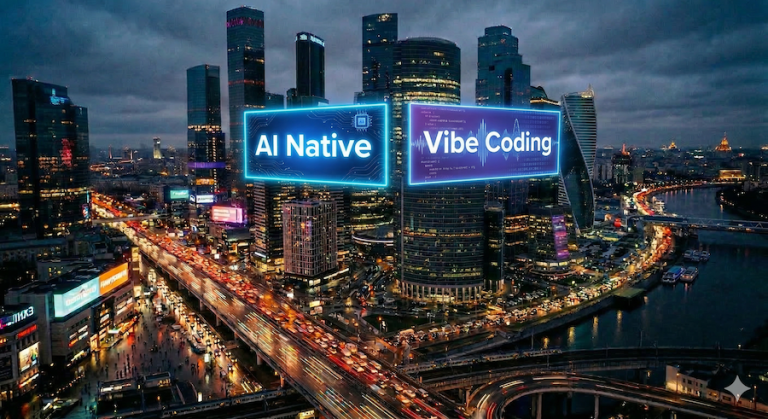
What’s actually happening is a split in approaches. On one side, we have structured, professional workflows known as AI Native development. On the other, a more chaotic trend often called “vibe coding”—where people rely heavily on AI tools without proper engineering practices.
Despite rapid adoption — with over 80% of developers already using AI tools — nearly half still don’t trust the accuracy of AI-generated code.
This creates a critical question: which approach actually works in 2026?
AI software development refers to the use of artificial intelligence tools and systems to assist, accelerate, or partially automate the process of building software. This includes writing code, testing, debugging, and even designing system architecture.
Unlike traditional development, AI doesn’t replace developers, it enhances their capabilities.
Today, AI is deeply embedded in development workflows:
In short, AI software development is about collaboration between humans and machines, not substitution.
AI is transforming how products are built and when used correctly, it creates significant advantages:
However, these benefits only fully materialize when AI is used within a structured development process.
Not all AI is the same. Modern development uses several categories:
Tools like ChatGPT and GitHub Copilot generate code, documentation, and logic suggestions.
Used in applications like recommendation systems, fraud detection, and predictive analytics.
Enables chatbots, search systems, and AI assistants.
Used in image recognition, security systems, and automation tools.
Understanding these types is essential for applying AI correctly in software engineering.
AI supports every stage of development:
This is where AI in software engineering delivers the most value as a system-wide accelerator.
AI Native development is a structured approach where AI is integrated into the development process intentionally and strategically.
It is:
In practice, AI Native development looks like this:
This approach blends AI native development with AI-assisted development, ensuring that AI enhances productivity without compromising quality.
“Vibe coding” is a more informal, tool-driven way of building software. It often involves prompting AI tools to generate code without deep planning or technical oversight.
It’s popular because it’s fast and accessible.
One of the biggest hidden problems with this approach is how AI actually solves problems. Most AI tools focus on generating a working solution without considering the existing architecture of the system.
In practice, this often leads to:
Experienced engineers take a different approach. Instead of asking “how do we solve this problem?”, they ask: “how do we solve this with minimal changes to the existing system?”
AI solves the task. Engineers design the system.
Typical traits include:
This approach isn’t inherently bad, but it becomes risky when used for serious products.
In practice, this often leads to increased debugging time, hidden vulnerabilities, and unstable systems — especially when teams rely on AI outputs without proper validation.
| Factor | AI Native Development | Vibe Coding |
|---|---|---|
| Scalability | Designed for growth | Breaks under load |
| Maintainability | Clean, structured code | Hard to manage |
| Security | Built-in from start | Often overlooked |
| Speed | Fast + sustainable | Fast but unstable |
| Reliability | High | Inconsistent |
| Team Involvement | Engineers + AI | Mostly AI-driven |
The key takeaway: both approaches use AI, but only one is built for long-term success.
To understand the difference in practice, consider how AI is used in real-world products:
We’ve also seen cases where products built primarily with AI tools required full rewrites within months due to poor architecture and lack of scalability.
Research shows that AI-generated code can introduce hidden risks when used without engineering oversight. While adoption is growing quickly, developers themselves remain cautious: 84% are already using or planning to use AI tools in development, yet 46% say they do not trust the accuracy of AI output. Code-focused research also shows that current LLMs frequently overlook security issues during generation and repair.
In addition, code-generating models can hallucinate package names — suggesting dependencies that do not exist. A 2025 study found hallucinated package rates of at least 5.2% for commercial models and 21.7% for open-source models, highlighting how convincing but incorrect output can create real software supply-chain risk.
This creates a dangerous illusion: code looks correct, but fails under real-world conditions.
AI tools can generate code quickly, but without proper oversight, they introduce serious problems.
AI-generated code often lacks structure. Over time, this leads to:
This is especially critical in Web3 and fintech.
Common issues include:
What works for 100 users may fail at 10,000.
Without proper architecture:
Ironically, “cheap” AI development often becomes expensive later due to:
These are the real risks of AI coding when done without engineering expertise.

AI is incredibly powerful, when used correctly.
AI excels at:
AI allows teams to:
With AI:
This is where AI in software engineering truly shines—as an accelerator, not a replacement.
Most teams today either over-rely on AI (vibe coding) or avoid it completely. The real advantage comes from structured AI-augmented development especially in Web3.
See how this approach works in real products: AI-Augmented Web3 Development
We apply this approach across:
In practice, this means faster delivery without sacrificing reliability.
There are cases where vibe coding actually makes sense.
Use AI alone for:
In these scenarios, speed matters more than structure.
For anything serious, you need experts.
Investors expect:
If you plan to grow, architecture matters from day one.
These industries require:
This is where AI Native development becomes essential.
No. AI enhances developers but cannot fully replace engineering expertise, especially for complex systems.
AI Native is structured and professional, while vibe coding is informal and tool-driven without strong architecture.
Yes, for prototypes and small projects—but not for scalable products.
Technical debt, security vulnerabilities, scaling issues, and long-term costs.
By automating tasks, speeding up coding, and improving efficiency.
When building funded startups, scalable platforms, or secure systems like Web3 or fintech apps.
AI is transforming how we build software, but it’s not replacing engineering. The real advantage comes from combining AI tools with structured development practices.
AI Native development represents the future: fast, scalable, and reliable.
Vibe coding, while useful in certain contexts, simply doesn’t hold up for serious products.
The winning formula in 2026 is clear: AI + experienced engineers = successful software.