
A trust wallet clone script is a practical way to launch a crypto wallet product without building core functionality from scratch.
Instead of spending months on wallet infrastructure, teams start with a ready-made foundation that already includes multi-chain asset management, Web3 connectivity, and production-ready mobile apps and then customize it for their product and business model.
This page explains how a Trust Wallet–like solution is structured, what’s included in a typical implementation, and how teams use it to launch faster and reduce development risk.
If you’re evaluating feasibility, you can also explore a detailed cost breakdown and delivery scope.
A Trust Wallet clone script gives you a structured way to launch a crypto wallet product without building core infrastructure from scratch.
Instead of spending months on wallet development, you start with a ready-made foundation that already includes the essential flows and UX patterns users expect.
This allows your team to focus on product differentiation — supported networks, integrations, monetization, and user experience — rather than rebuilding standard wallet functionality.
The result is a faster, more predictable launch with less technical risk and a clear path to scaling your product.
A Trust Wallet clone script is typically chosen by teams that need to launch a working crypto wallet quickly while keeping flexibility for future growth.
If you’re comparing different wallet approaches, see our Trust Wallet vs MetaMask comparison (security, supported chains, and use cases).
A Trust Wallet clone app is typically used to launch multi-chain wallets for DeFi platforms, NFT ecosystems, and Web3 applications.
Depending on your product goals, the solution can be adapted for different use cases, including asset management, dApp access, and token-based ecosystems.
A Trust Wallet clone script includes all core components required to launch and operate a production-ready crypto wallet.
The base solution includes wallet onboarding, multi-chain asset management, transaction handling, and Web3 connectivity aligned with familiar wallet UX patterns.
The product is delivered as a mobile application for iOS and Android, including secure on-device storage, biometric authentication, and app store readiness.
Additional functionality can be added depending on your product strategy:
| Feature | Basic Clone | Advanced Version |
|---|---|---|
| Deployment Time | 3 weeks | 4–8 weeks |
| Supported Chains | Ethereum, BNB Chain, Polygon | All EVM + Solana, Bitcoin |
| Web3 / dApp Support | WalletConnect | Custom integrations + extended UX |
| Security Level | Standard security setup | Advanced security + audits |
| UI/UX Customization | Template-based | Fully custom design |
| Optional Features | Limited | Swaps, staking, NFTs, fiat integrations |
A Trust Wallet clone script is not just about faster development — it helps reduce execution risk and gives you a clear path from idea to launch.
Instead of building core wallet functionality from scratch, you start with a ready-made foundation. This significantly reduces development time and allows you to launch your product in weeks rather than months.
With a structured baseline, it’s easier to define what’s included in the initial release and what can be added later. This helps avoid scope creep and keeps development aligned with your timeline and budget.
The solution is designed to grow with your product. You can add features like swaps, staking, NFTs, or new networks without rebuilding the core wallet.
You can launch under your own brand while using proven UX patterns that users already trust. This helps reduce onboarding friction and improves early user adoption.
The product is delivered with the necessary release setup, security practices, and monitoring tools required to operate and support a live wallet application from day one.
If you’re planning your wallet launch, the next step is to define the scope and cost based on your product requirements. You can explore a detailed cost breakdown and delivery scope.
A Trust Wallet clone can generate revenue through multiple built-in mechanisms, depending on your product strategy and integrations.
Revenue can be generated through swap integrations via routing fees or partner commissions, depending on the provider and supported networks.
Some products include a small service fee on top of network fees, where supported and transparently implemented.
If staking is enabled, revenue can come from a share of staking rewards or partner commissions.
Wallets can generate revenue through referral or volume-based commissions from fiat providers.
Some products monetize through promoted listings or integrations, depending on the product strategy.
Advanced features such as analytics tools, alerts, or enhanced security options can be offered as paid upgrades.
A Trust Wallet–like wallet is built as a modular system with clearly defined layers, allowing for scalability, security, and stable performance.
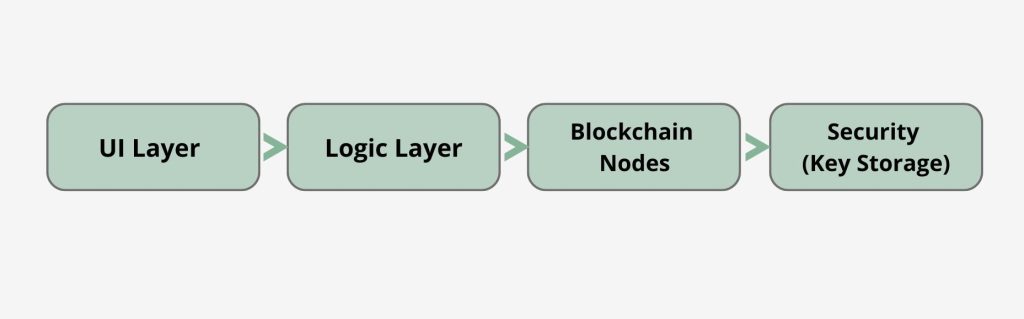
Common implementations include React Native or Flutter for mobile apps, Node.js for backend services, and integrations with blockchain APIs and data providers.
A wallet is not defined by features alone, it’s defined by how core user flows work in real conditions.
Users should be able to create or import a wallet, access their assets, and complete a transaction without friction. This includes correct balances, accurate fees, and clear transaction tracking.
Web3 interactions must be clear and predictable. Users need to understand what they are approving, confirm actions safely, and track results (pending, confirmed, failed).
A Trust Wallet–like solution should include secure on-device key storage, biometric or PIN-based access, and consistent transaction confirmation flows.
For Web3 interactions, the key requirement is clear signing UX — users must understand what they approve and avoid risky actions.
Security should also be supported by proper release practices, including testing, secure builds, and controlled deployment processes.
Wallet performance depends on how balances, transactions, and token data are handled across networks.
Reliable implementations use multiple providers, indexing services, and caching strategies to ensure consistent data and stable performance.
When evaluating a solution, it’s important to understand how data is sourced and how the system handles network or provider issues.
The final cost depends on your product scope, supported networks, and required features.
For a detailed breakdown, see our Trust Wallet clone app development cost guide.

Most teams don’t need just a “clone.” They need a wallet they can launch, operate, and scale without rebuilding the core product. ND Labs focuses on delivering that outcome.
A Trust Wallet clone script is a ready-made wallet solution that allows you to launch a crypto wallet product under your own brand. It includes core functionality such as multi-chain asset management, Web3 connectivity, and transaction handling — without building everything from scratch.
Essential security features include secure on-device key storage, biometric or PIN-based access, and clear transaction confirmation flows. For Web3 interactions, users should always understand what they are approving and be protected from common risks.
A clone script is typically chosen when you want faster launch and more flexibility in customization. A white-label solution is more configuration-based and works well when you need predictable setup with less development effort. The right choice depends on your product scope and long-term goals.