
Building an NFT marketplace is not just about deploying smart contracts. It’s about creating a product where users can discover, buy, and interact with digital assets without friction.
This guide breaks down how to build an NFT marketplace step by step, including business models, blockchain selection, core features, architecture, costs, and launch options.
Whether you are a startup validating an idea or a brand launching a Web3 product, this guide will help you choose the right approach — from white-label solutions to fully custom development.
If you want the short version, here’s the build path we use on real projects. First, define your marketplace model (open, curated, niche, or enterprise) and the utility you’re actually shipping—drops, tickets, gaming items, memberships, or phygital bundles. Next, pick a chain (or go multichain) based on your audience and fee tolerance. Then design the marketplace UX around onboarding and checkout, not crypto jargon. After that, you build the core NFT marketplace smart contracts (minting, listings, auctions/offers, and royalties), connect wallets and payments (crypto and optional fiat on-ramps), and set up storage and indexing for fast discovery. Finally, you harden security (audits, anti-fraud, moderation), launch with analytics, and iterate based on real user behavior, not assumptions.
If you want to launch faster, many teams skip part of this process by using a white-label NFT marketplace solution instead of building everything from scratch.
There’s no single correct model; choose the one that fits your brand and fans:
One size doesn’t fit all; strategy drives architecture. Understanding these marketplace types helps teams define what kind of NFT marketplace they need to build and which audience it should serve. Choosing the right model early makes it much easier to plan features, UX, and the overall NFT marketplace development roadmap.
If you want a detailed explanation of marketplace types and real-world examples, we cover that separately in our guide on what is an NFT marketplace.
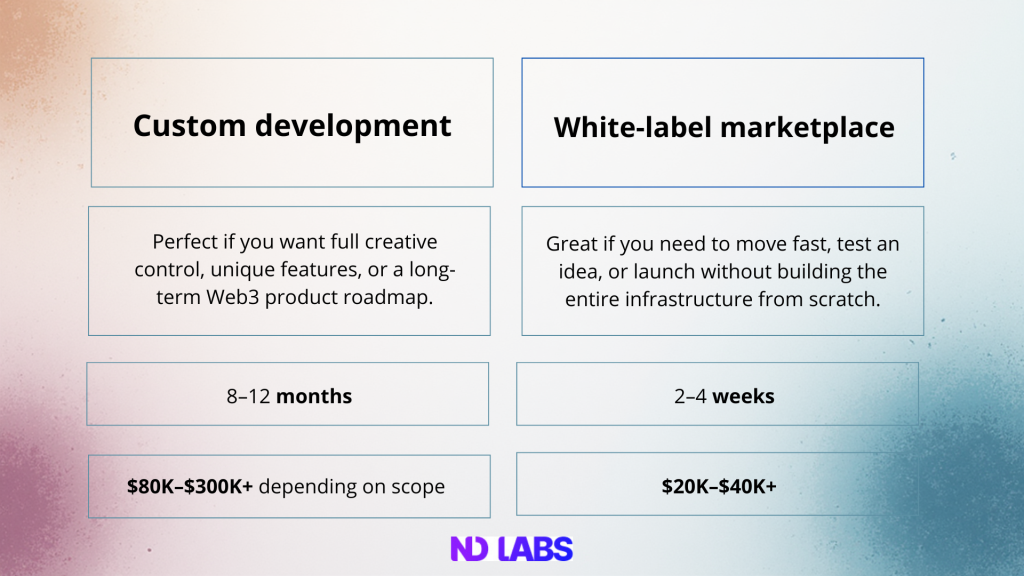
One of the first decisions you’ll need to make is whether to build your marketplace from scratch or use a white-label solution.
In practice, most teams start with a white-label solution to validate their idea and go to market quickly, then evolve toward custom development as the product grows.
Explore our white-label NFT marketplace platform to see how this approach works in practice.
Choosing a blockchain is a product decision, not just a technical one. It affects transaction fees, user experience, scalability, and how easily new users can join your marketplace.
Before selecting a blockchain, consider four key factors: your audience, the type of assets you plan to support, payment preferences (crypto vs fiat), and acceptable transaction costs.
Ethereum remains the most established ecosystem for NFT marketplaces, especially for premium collections and long-term projects. Layer-2 solutions like Arbitrum, Optimism, and Base significantly reduce fees and improve transaction speed while keeping Ethereum-level security.
Best for: high-value assets, art marketplaces, and projects focused on long-term credibility.
These blockchains are optimized for scale and affordability. They offer low transaction fees and are well-suited for marketplaces targeting large audiences or frequent transactions.
Best for: mass-market platforms, brand campaigns, ticketing, and marketplaces with high user activity.
Solana is known for high speed and very low fees. It is widely used in gaming and community-driven NFT ecosystems where frequent trading and engagement are essential.
Best for: gaming marketplaces, fast trading environments, and mobile-first audiences.
TON is gaining traction due to its integration with Telegram. It enables NFT marketplaces to reach users directly within messaging ecosystems and mobile-first environments.
Best for: social-driven platforms, viral distribution, and Telegram-based products.
Tezos is a popular choice for digital art and culturally driven projects due to its low energy consumption and strong community of artists and creators.
Best for: art-focused marketplaces and cultural ecosystems.
Many teams start with a single blockchain to simplify development, then expand to a multi-chain setup as their marketplace grows. This allows you to test your concept quickly while keeping flexibility for future scaling.

A modern NFT marketplace may look simple to users, but behind the interface it is a system of multiple components working together in real time. Understanding this architecture helps explain why building a marketplace is more than just deploying smart contracts.
In practice, an NFT marketplace consists of several core layers:
One of the most underestimated components is the indexing layer. Most performance issues in NFT marketplaces are not caused by the blockchain itself, but by how quickly listings, traits, and activity data can be processed and displayed.
Smart contracts act as the trust engine of the marketplace. They define how assets are created, listed, sold, and transferred. In most real-world platforms, multiple contracts or modules are used rather than a single contract.
Storage is equally critical. Images, videos, and metadata must remain available long-term, which is why decentralized storage and backup strategies are essential to prevent broken assets.
For marketplaces targeting mainstream users, the checkout flow becomes a key architectural priority. Wallet creation, payment integration, and onboarding must be designed before anything else, since friction at this stage directly impacts conversion.
Because of this complexity, many teams choose to use a white-label NFT marketplace solution instead of building every component from scratch. This allows them to focus on business logic, audience growth, and product differentiation while relying on proven infrastructure.
The success of an NFT marketplace depends on how quickly users can move from discovery to purchase. A strong UX removes friction, builds trust, and makes the buying process feel as simple as any modern app.
Rule of thumb: if a first-time user cannot complete a purchase within a few minutes, conversion drops significantly. This is why onboarding and checkout should be prioritized over advanced features.
Below are the core UX and product features required for a scalable NFT marketplace:
Key takeaway: A successful NFT marketplace is not just about blockchain technology. It is about reducing friction, improving trust, and designing a product that users actually want to return to.
Mobile-First Experience
Most users discover NFT products on mobile devices — through social media, messaging apps, or in-app notifications. This makes mobile experience a critical part of marketplace design.
- Fast, app-like interface optimized for mobile usage
- Integration with social and gaming ecosystems
- Push notifications for drops, bids, and activity
- Biometric authentication for secure access
- Built-in sharing and viral distribution mechanics
For many users, mobile is their first interaction with Web3. A frictionless mobile experience directly impacts acquisition, engagement, and conversion.
Using public NFT marketplaces gives you access to an existing audience, but it also means you rely on someone else’s platform, rules, and monetization model.
Launching your own NFT marketplace gives you full control over how your product works, how users interact with it, and how value is created and captured.
For many businesses, an NFT marketplace becomes more than just a trading platform. It evolves into a core product that supports community growth, engagement, and long-term revenue.
Security is one of the most critical aspects of any NFT marketplace. Users need to trust that their assets, transactions, and data are protected at every stage.
A production-ready NFT marketplace should include:
Security should be built into the architecture from the beginning, not added later. Weak security can damage user trust and limit long-term growth.
If you want a deeper breakdown of common threats and protection strategies, read our NFT security guide.
There are two main ways to launch an NFT marketplace, depending on your goals, timeline, and level of customization required.
Best for: startups, MVPs, and businesses that want to validate ideas and go to market quickly.
Best for: companies building long-term platforms with complex business logic or unique user experiences.
In practice, many teams start with a white-label NFT marketplace solution to launch faster, then evolve toward custom development as their product grows.
Teams planning custom development should also understand how to evaluate marketplace developers across relevant case studies, payment experience, delivery ownership, security capabilities, and post-launch support.
To build an NFT marketplace, you need a blockchain infrastructure, smart contracts for minting and trading, wallet integration, backend systems, a scalable frontend, metadata storage, and a clear business model.
The cost depends on features and complexity. White-label solutions are more affordable and faster to launch, while custom NFT marketplace development typically ranges from $80,000 to $300,000+.
A white-label NFT marketplace can be launched in 2–3 weeks. Custom development usually takes between 8 and 12 months depending on complexity.
Popular options include Ethereum (with Layer-2), Polygon, BNB Chain, Solana, and TON. The best choice depends on your audience, transaction volume, and product goals.
NFT marketplaces generate revenue through transaction fees, primary sales, royalties, subscriptions, token-gated access, and sponsored drops.
If you want to launch quickly and validate your idea, a white-label solution is the best starting point. Custom development is better suited for complex products with unique features and long-term scalability.
Yes, many modern NFT marketplaces integrate fiat on-ramps, allowing users to buy NFTs using credit cards or local payment methods.