Decentralized identity (DID) and self-sovereign identity (SSI) often appear in the same sentence, and many projects use the same technologies for both. But they are not identical concepts.
DID is mainly about the technical standards and plumbing – how identifiers and verifiable credentials work.
SSI is more of a philosophy and governance model – who is in control, and how much power users really have over their data.
If you’re deciding how to build identity into your product, it helps to see clearly where they overlap and where they differ. The sections below give quick, practical definitions before we dive into the detailed comparison.
Quick Definitions
What Is Decentralized Identity (DID)?
Decentralized identity is an approach to digital identity based on three core ideas:
Decentralized identifiers (DIDs) – globally unique identifiers that users, organisations, or devices can create and control without a central authority.
Verifiable credentials (VCs) – digitally signed statements about those identifiers (KYC status, age, role, diploma, licence, etc.) that can be checked cryptographically. We cover them in more detail in our main decentralized identity guide.
Independent verification – apps can verify credentials without calling the issuer every time, using public keys and revocation lists instead.
DID focuses on standards and infrastructure:
how DIDs are created and resolved;
how credentials are issued, stored, and verified;
how different wallets, platforms, and ecosystems can interoperate.
It doesn’t force one specific governance model. The same DID tech can be used by:
In short, DID answers the question: “How do we technically represent and verify identity data in a decentralized way?”
What Is Self-Sovereign Identity (SSI)?
Self-sovereign identity is more about principles and power balance than about specific protocols.
An SSI system is built around a simple idea:
The person (or organisation) that the identity describes should be at the centre of every decision about it.
In practice, SSI usually means:
User control first – individuals own their identifiers and credentials, typically in a wallet or agent they control.
Minimal intermediaries – third parties like platforms or governments should not be able to silently profile or track users across services.
Portability – users can take their identity data with them when they switch providers or move between ecosystems.
Privacy by design – selective disclosure, zero-knowledge proofs, and strong consent flows are treated as core requirements, not extras.
Most modern SSI implementations use DID and verifiable credential standards under the hood, but they apply them with a strong commitment to user autonomy and open governance.
So, while DID answers “how does the tech work?”, SSI answers: “Who is in charge of the identity, and what rights do they have?”
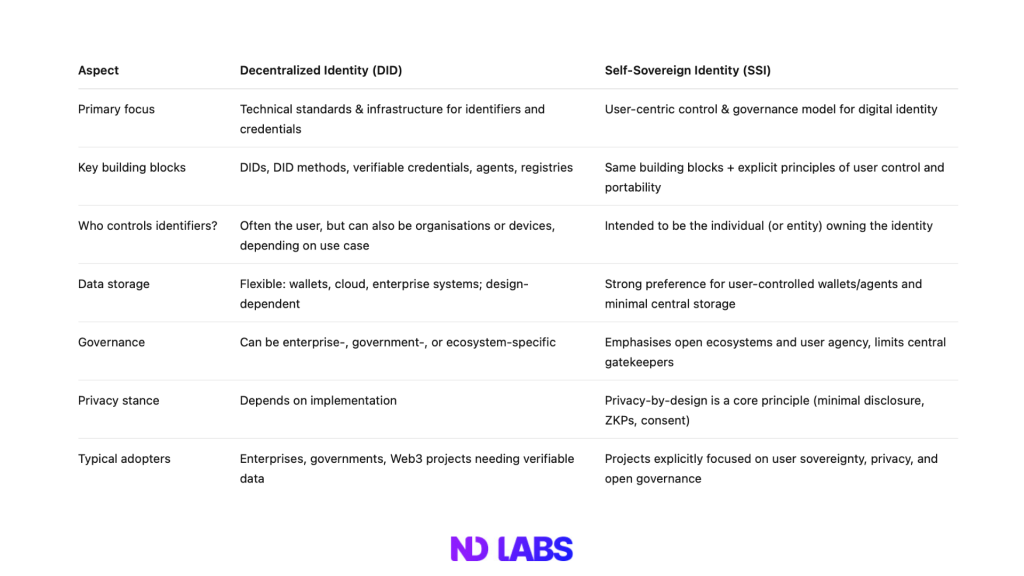
DID vs SSI at a Glance
Here is a simplified comparison to orient yourself before we go into more detail.
DID and SSI are not opponents. SSI is usually built on top of DID, but with stricter expectations around control, privacy, and governance.
Key Differences Explained
1. Trust & Governance Model
DID
Provides the mechanisms for trust: DIDs, credentials, signatures, revocation.
Governance can be very different from one ecosystem to another:
a bank consortium,
a government-led programme,
a permissionless Web3 network.
There may still be strong central actors (large issuers, platforms, state authorities) inside a DID-based system.
SSI
Starts from a clear set of principles: user control, portability, transparency, minimal central gatekeepers.
Trust is distributed between many issuers and verifiers, while the user sits at the centre.
Governance efforts usually aim to avoid any single organisation becoming a permanent gatekeeper for identity.
If you think of DID as a “toolkit”, SSI is a particular way of using that toolkit with explicit values and rules.
2. Data Storage & Control
DID
Is flexible about where data is stored:
in user wallets or agents;
in enterprise databases;
in cloud services;
or some combination.
A DID system can be privacy-friendly or not—it depends on how credentials, logs, and metadata are handled.
You can absolutely build a DID-based system that still stores a lot of data centrally if that’s the design.
SSI
Strongly favours user-controlled storage of credentials (wallets, personal agents, data vaults).
Central services should hold as little personal data as possible and rely on verifiable credentials instead.
Portability is key: if users cannot pick up their credentials and move, it’s not really self-sovereign.
In other words, control over data location and movement is stricter in SSI than in generic DID systems.
3. Privacy & Selective Disclosure
DID
Provides standards and mechanisms for:
verifiable credentials,
selective disclosure,
zero-knowledge proofs,
off-chain storage.
Whether these are actually used is a design choice.
Some DID systems might implement only basic credentials and leave privacy optimisations for later.
SSI
Treats privacy-by-design as a non-negotiable requirement.
UX might initially look close to existing SSO or enterprise identity flows, with DIDs and credentials hidden under the hood.
SSI
Puts the user at the centre from day one:
wallet/agent UX,
clear consent screens,
portable identity experience across providers.
Adoption can be slower, because it sometimes challenges existing platform-centric businesses and requires more UX work.
For some audiences, it may be easier to start with DID-based improvements and then move toward more SSI-like experiences as users become familiar with identity wallets and credentials.
If you want to see how identity and wallets blend into everyday UX, our article Will wallets replace passwords explores that direction.
5. Typical Use Cases
DID is often chosen when:
Enterprises need verifiable data exchange between departments, partners, or subsidiaries.
Governments want digital IDs that can be verified by many services.
Web3 protocols need a way to tie verifiable attributes to wallets (KYC status, membership, credit profiles).
The main goal is user autonomy and privacy, especially across borders and providers.
Projects work with populations that are under-served by traditional identity systems (refugees, unbanked communities).
There is a strong civil-society or ecosystem push to avoid new centralised identity monopolies.
In practice, many systems sit somewhere on a spectrum: DID-based, with more or less self-sovereign characteristics depending on design choices.
Which Model Fits Your Product?
There is rarely a strict “DID vs SSI” decision. Instead, the question is:
“How far toward self-sovereign principles do we want to go, given our users, regulators, and business model?”
A few guiding questions:
Who needs to be in control of credentials?
If user control and portability are core value propositions, you’ll want to lean toward SSI principles.
If your main need is verifiable data exchange between organisations, a DID-first design may be enough initially.
How sensitive is the data?
The more sensitive and long-lived the data, the stronger the argument for privacy-by-design and user-controlled storage.
What are your regulatory constraints?
In highly regulated environments, you may need more explicit governance and auditability—the tech choice should support that.
What kind of UX can your users handle today?
Some audiences are ready for identity wallets and credential choices. Others might need wallet-like flows that feel almost invisible.
Not Sure Whether You Need DID or SSI?
Share your use case and constraints, and we’ll help you decide whether a DID-first, SSI-first, or hybrid approach makes the most sense for your product.
Start with DID infrastructure and verifiable credentials to solve immediate pain points (KYC reuse, access control, verification).
Gradually move more control to user wallets and agents, following principles from SSI and privacy-first DID design
Introduce stronger SSI-style features such as context-specific identifiers, advanced selective disclosure, and portable identity experiences.
At ND Labs, we work with companies and ecosystems that want to move beyond fragile, password-based, platform-locked identity.
We can help you:
Clarify whether you need DID infrastructure, SSI principles, or a mix of both.
Design an architecture for decentralized identifiers, verifiable credentials, and wallets that fits your regulation and risk profile.
Build or customise identity-ready non-custodial wallets that can be extended with decentralized identity and verifiable credentials, using our white-label wallet development services
Integrate DID and SSI patterns into your existing apps and back-end systems.
Prototype and launch real-world use cases (KYC reuse, compliant DeFi access, workforce access management, education credentials, and more).
Suppose you’re considering decentralized identity, self-sovereign identity, or both. In that case, we’re happy to review your use cases and suggest a practical way forward, whether you’re starting with a small pilot or planning a larger ecosystem.
Let’s Talk
Whether you’re exploring decentralized identity, self-sovereign identity, or both, we can help you plan a realistic path from pilot to production.